If you’ve spent any time at a shooting range, you’ve probably seen it firsthand: two shooters with the exact same AR-15 setup, but one is hitting steel plates at lightning speed up close, while the other is tight-grouping shots on paper at 300 yards.
The difference usually comes down to what’s mounted on the top rail.
The AR-15 is built to be a multi-purpose rifle, but out of the box, it’s only as effective as the optic you pair with it. The debate between a red dot sight and a magnified scope isn’t new, but choosing the right one can get confusing real quick when you’re buried in technical specs like parallax, eye relief, and MOA.
As a professional optics manufacturer, we build and test these systems every day. In this guide, we’ll break down how red dots and scopes actually perform in the real world—no hype, just straightforward facts to help you pick the right gear for your setup or retail shop.
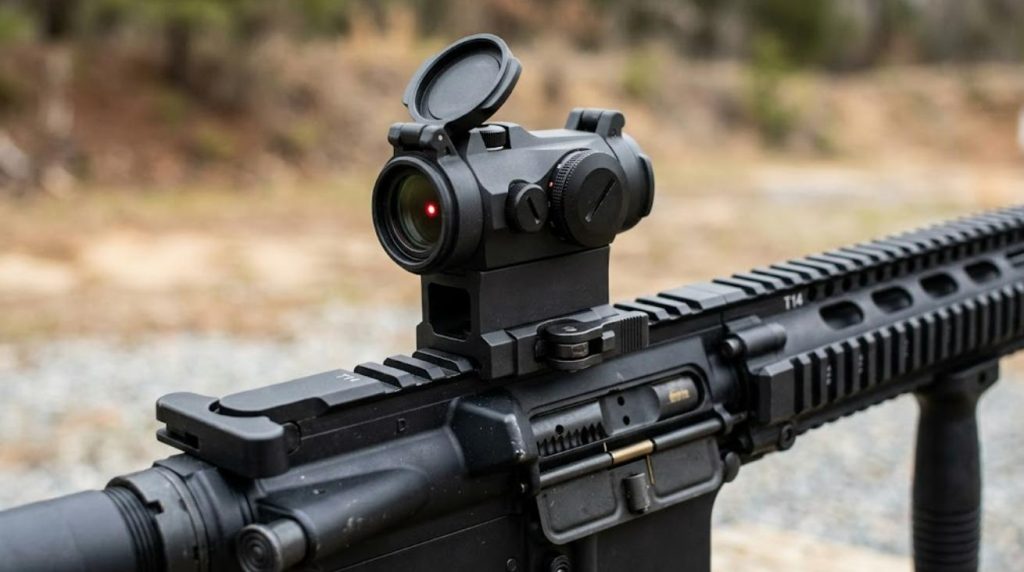
Red Dot Sights: Built for Speed and Close-Quarters Action
When it comes to raw speed, nothing beats a solid red dot.
The physics behind a red dot is actually pretty simple: a tiny LED diode inside the housing projects a beam of light onto a specially coated glass lens. The lens reflects that red (or green) light back toward your eye while letting natural light pass straight through. What you see is a bright, glowing point sitting right on your target.
What Makes Red Dots So Practical?
- Unlimited Eye Relief: With a scope, your eye has to sit at a specific distance from the glass to get a full view. With a red dot for ar 15 rifles, it doesn’t matter if your cheek weld is off-center or if you’re shooting around a barrier—if you see the dot on the target, that’s where the shot goes.
- Shooting with Both Eyes Open: Red dots are meant to be used with both eyes wide open. This gives you a natural, full field of view so you don’t lose track of your surroundings.
- Lightweight & Low Profile: Most red dot sights weigh between 4 to 8 ounces. They keep your rifle nimble, easy to swing between targets, and comfortable to carry all day.
- Long-Lasting Battery Life: Modern LED setups draw tiny amounts of power. Combined with motion-activated “shake-awake” tech, a single CR2032 battery can easily last 20,000 to 50,000+ hours.
The Pros and Cons
Red dots are great, but they aren’t built for everything. Since they offer no magnification (1x), spotting or hitting small targets past 100 or 150 yards gets tricky. Also, if you have astigmatism, the dot might look a bit blurry, streaked, or like a small cluster of grapes instead of a crisp circle—though turning down the brightness or switching to a green dot usually helps a lot.
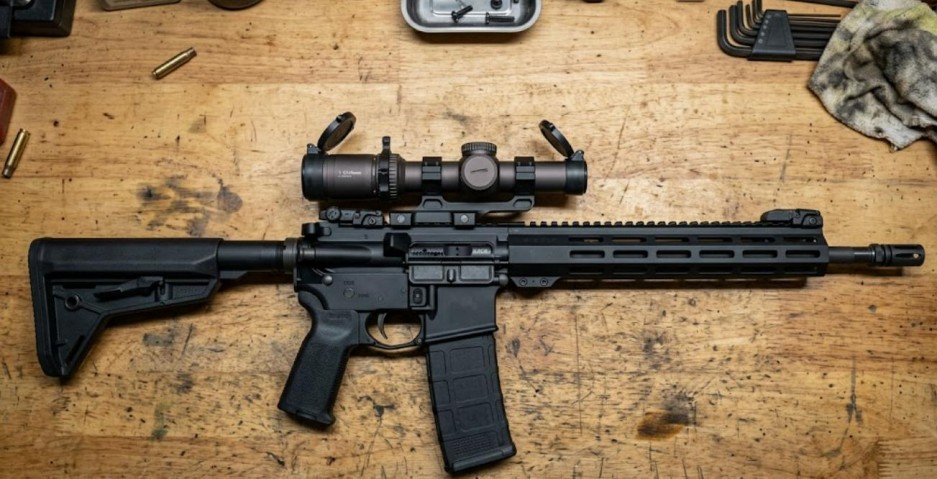
Scopes & LPVOs: Precision and Distance
If you need to push your AR-15 out to 200, 300, or 500 yards, a magnified scope for ar15 rifles—especially a Low Power Variable Optic (LPVO)—is going to be your best friend.
An LPVO gives you variable magnification (typically 1-6x or 1-8x) in a single optic. Turned down to 1x, it functions very much like a red dot. Dial it up to 6x or 8x, and suddenly you can clearly identify targets and place shots with precision way out in the field.
Why Go with a Magnified Scope?
- Target Identification: Magnification doesn’t just help you hit a target—it lets you see what you’re shooting at. Whether you’re spotting small targets on paper or hunting game, glass quality and magnification make a huge difference.
- Etched Reticles (No Battery Required): Most modern rifle scopes use glass-etched reticles. That means even if your battery completely dies, the black reticle is still right there in the glass, fully functional.
- BDC & Windage Holds: Scopes usually come with Bullet Drop Compensator (BDC) reticles. Once you know your ammo’s ballistics, these marks tell you exactly where to hold for distance without twisting knobs mid-shoot.
- Clear for Astigmatism: Because you can adjust the diopter on the scope eyepiece to match your own vision, ar15 scopes provide a razor-sharp reticle even for shooters with astigmatism.
What’s the catch?
More glass and internal moving parts mean extra weight. An LPVO plus a solid mount can easily add 20 to 28 ounces to your top rail. You also have to deal with eye relief (typically 3.5 to 4 inches) and a limited “eyebox,” meaning your head position needs to be consistent every time you shoulder the rifle.

AR15 Scope or Red Dot: Which One Matches Your Needs?
If you’re weighing an ar15 red dot or scope, here is how they stack up side by side:
| Feature | Red Dot Sight | Rifle Scope / LPVO |
| Effective Distance | 0 – 100+ Yards | 100 – 500+ Yards |
| Target Acquisition | Instant (Unlimited eye relief) | Fast to Moderate (Requires eye alignment) |
| Average Weight | 4 – 8 oz | 18 – 28 oz (Scope + Mount) |
| No-Battery Failover | No (Back-up iron sights needed) | Yes (Glass-etched reticle stays visible) |
| Astigmatism Friendly | Can starburst/blur | Very clear (Diopter adjustable) |
| Overall Setup Cost | Generally lower | Higher (Scope + precision mount) |

If you’re still torn between an ar15 scope or red dot, asking a few practical questions usually clears things right up:
- Where do you shoot most of the time?
If 90% of your range time is under 100 yards, or if your rifle is set up for home defense, a red dot is faster, lighter, and easier to use. If you shoot outdoors at longer distances, magnification makes life much easier.
- How much weight do you want on your rifle?
A light rifle handles fast. If you’re moving around a lot, running tactical drills, or carrying your gear for hours, keeping it light matters. If you’re shooting off a bench or a bipod, the extra weight of a scope actually helps stabilize your shots.
- Have you considered a hybrid setup?
You don’t always have to pick just one. A popular setup nowadays is pairing a red dot with a 3x magnifier on a flip-to-side mount. You get a clean 1x dot for close-up speed, and you can flip the magnifier in place whenever you need a bit more reach.
Manufacturing & Sourcing Insights for Retailers and Brands
For gun shop owners, tactical retailers, and optics brands, understanding how shooters use ar15 optics helps build a better inventory strategy.
In real-world retail, customers rarely stick to just one style. Beginners often start with an easy-to-use red dot, while experienced shooters frequently add LPVOs, magnifiers, or offset mounts to their collection.
As a direct manufacturer, we test our optics to handle heavy recoil (shockproof up to 1000g+), nitrogen-purge them to prevent internal fogging, and ensure rock-solid zero retention—so your customers get reliable gear and your shop avoids high return rates.
Wrapping It Up
At the end of the day, there’s no single “best” optic for every AR-15. It all comes down to what you need your rifle to do. If speed, light weight, and quick target pickup are your main goals, a good red dot is tough to beat. If you want clear target identification, distance, and precision, an LPVO or traditional scope is well worth the extra weight.
Looking for Reliable Optics Sourcing or Custom OEM Manufacturing?
Whether you’re looking to stock proven red dot sights, crisp LPVO scopes, or develop custom-branded optics for your own tactical line, Foreseen Optics provides factory-direct solutions built to perform.
- Built Tough: Recoil-rated, waterproof, and fog-proof for real-world durability.
- Custom OEM/ODM Support: Custom logo laser engraving, reticle designs, and flexible MOQs.
- Direct Supply Chain: Quality manufacturing with competitive wholesale pricing.
Contact Foreseen Optics Today for Product Catalogs and Wholesale Pricing