The lenses of many red dot scopes are not completely transparent. Different models present colors such as blue, green, amber, purple or pale red. Will these color variations affect the image that the naked eye sees through the scope? More importantly, will they interfere with shooting accuracy?
In most cases, the coloration of the lenses comes from optical coatings. The main function of these coatings is to reduce reflections, making the red dot markings clearer. However, they also change the amount of light transmission, color reproduction, and image clarity.
The key is to understand exactly what role the lens coloration plays and in what actual scenarios it will have a substantive impact.
Why Do Red Dot Sights Have Tinted Lenses?
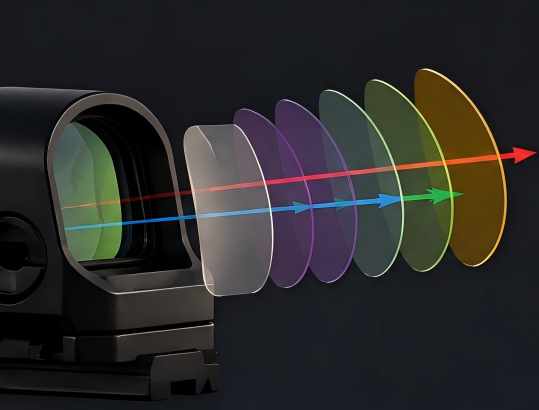
The coloration of the lenses is not an aspect of the design, but rather a result of the optical coating. The coating is used to control the reflection and transmission of light, aiming to create a clear red dot aiming point while also ensuring that the user can clearly see the external target through the lenses.
The Role of Optical Coatings
The red dot sight projects light through LEDs onto the specially coated lenses. The coating reflects the aiming marks emitted by the LEDs into the human eye while allowing most of the external light to pass through the lenses.
As a result, the red/green aiming points will superimpose on the target image without blocking the view.
The coating needs to balance two properties: it must reflect sufficient LED light to ensure clear aiming points; and it must allow enough external light to pass through to maintain a clear view of the observed image.
The coating reacts differently to different wavelengths of light, which causes the visible color effect on the lenses.
Why the Lens May Appear Blue, Green, Amber, or Purple

Different coating schemes will result in different colors for the lenses. Depending on the wavelength of the reflected light, the lenses will show tones such as blue, green, purple, amber, etc.
One more feature of multi-layer coating is that the color of the lens will change as the viewing angle changes.
In addition, the color seen on the outer surface of the lens is not the same as the color of the view through the lens. For example, if the external view of the lens appears dark green, the actual observed image is still close to its original color.
Therefore, solely relying on the appearance color of the lens cannot determine its optical quality.
How Does Lens Tint Affect What You See?
Lens tint can influence the viewing experience, but the effect depends on how strong the tint is and how the optical coating is designed.
A well-designed coating should support reticle visibility without significantly reducing target clarity.
Color Perception and Image Clarity

Colored lenses will slightly alter the color of the field of vision. Some coatings will make the picture appear cooler or warmer.
A slight color shift is generally not a problem in daily use; however, in outdoor conditions or in environments with variable lighting, obvious color differences can be easily noticed.
The clarity of the picture is not solely determined by the color of the lens; factors such as the lens material, the uniformity of the coating, the surface processing accuracy, and optical distortion all have a significant impact.
Even if the lens appears transparent to the naked eye, if the optical system has distortion or stray light reflection, its actual performance may not be excellent.
Contrast and Target Visibility
The right lens coating can help maintain contrast between the illuminated dot and the target area.
This can make the reticle easier to find quickly, particularly when the background is bright or visually complex.
However, stronger tint is not always better. If the coating reduces too much light transmission, the sight picture can appear darker.
This becomes more noticeable in shaded areas, indoor environments, or low-light conditions.
A good red dot sight should balance reticle brightness with a clear view of the target.
Reflections and Glare
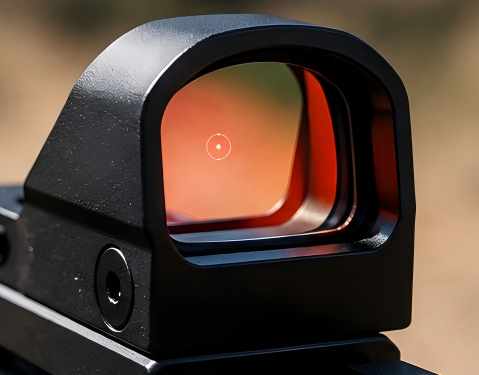
Optical coatings also help control unwanted reflections inside and outside the sight.
Without effective coatings, ambient light may create glare, ghost images, or reduced contrast. These issues can make the dot or target harder to see.
The visible lens tint is sometimes part of the same coating system used to manage these reflections.
However, lens tint alone does not guarantee good glare control. Housing design, lens angle, internal surfaces, and coating quality can also affect optical performance.
Does Lens Tint Affect Red Dot Accuracy?
This is one of the most common concerns among red dot sight users. The short answer is that lens color does not normally change the sight’s mechanical accuracy.
However, the quality of the sight picture can still influence how easily and consistently the user aims.

Lens Tint vs. Point of Impact
The blue, green, amber and purple lenses themselves do not directly affect the point of impact.
As long as the red dot sight is properly installed and the zeroing calibration is accurate, the appearance color of the lenses will not cause shooting deviation.
The mechanical accuracy is mainly influenced by factors such as the firmness of the sight installation, the stability of zeroing, the optical coaxiality, and the consistency of the aiming point.
Replacing the sight requires re-zeroing. This is usually caused by changes in optical components or installation positions, and is unrelated to the color of the lenses.
When Visibility Can Affect Shooting Performance
The color of the lens does not directly change the impact point, but it may interfere with the identification of the target or aiming point, thereby indirectly affecting the shooting performance.
For example, if the image is too dark, it will increase the difficulty of identifying the target in low-light conditions; severe glare and reflection will also destroy the clarity of the aiming point.
These situations are not due to the zeroing of the firearm or deviations in mechanical accuracy, but rather a deterioration of the optical field of view, making it difficult for the user to quickly and stably complete the aiming.
This also indicates that: even if the color of the lens itself does not affect zeroing, the overall observation field is still very crucial.

Does Lens Color Indicate Optical Quality?
Lens color by itself is not a reliable indicator of optical quality.
A strongly tinted lens is not automatically poor, and a nearly clear lens is not automatically better. Both can use different coating technologies and optical designs.
A better way to evaluate a red dot sight is to consider the complete viewing experience.
Look at image clarity, light transmission, color distortion, glare, internal reflections, and reticle visibility under different lighting conditions.
It is also useful to test the optic in realistic environments rather than judging it only by the appearance of the front lens.
The goal of a good optical design is not necessarily to make the lens completely colorless. It is to create a clear and functional sight picture while keeping the reticle easy to see.
Final Thoughts

Colored lenses are a common feature of red dot scopes. These colors are derived from optical coatings, which are used to control the light transmission and reflection of the lenses.
The slight blue, green, amber or purple tint of the lenses generally does not affect the aiming point or mechanical accuracy.
However, the entire optical design can change the brightness, color, contrast and reflection glare of the image, thereby affecting the user’s ability to aim quickly and comfortably.
When choosing a red dot scope, do not only look at the lens color, but also consider the actual observation performance.
A well-designed red dot lens should have clear divisions, sharp target imaging, and be able to work stably in various lighting conditions.