Replacing the battery in a red dot sight is usually a simple maintenance task. However, many shooters wonder whether changing the battery will affect the sight’s zero and whether the optic needs to be re-zeroed afterward.
In most cases, replacing the battery does not change zero if the red dot remains securely mounted. The situation can be different if the battery compartment is underneath the optic and the sight has to be removed from its mount.
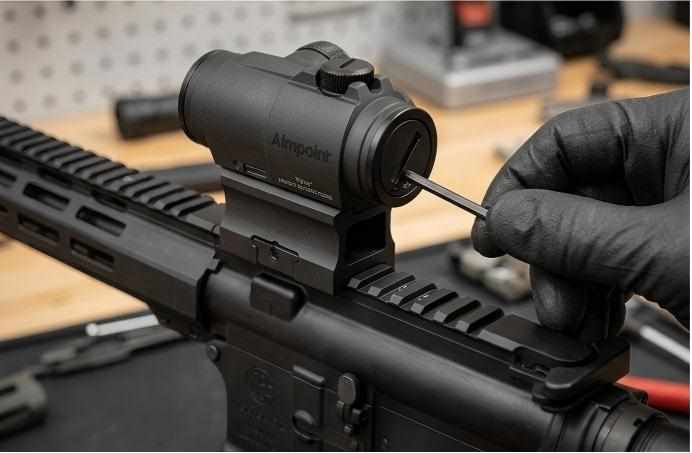
What Determines Whether a Red Dot Needs to Be Re-Zeroed?
If the Red Dot Stays Mounted
A battery provides power for the illuminated reticle, but it does not physically determine the optic’s mechanical alignment.
Therefore, if you can replace the battery without moving the sight or touching its adjustment controls, the battery replacement itself should not normally affect zero.
After installation, simply check that the reticle illuminates correctly and that the battery compartment is properly closed.
If You Have to Remove the Red Dot
Some red dot sights use a bottom-loading battery compartment. Depending on the design, accessing the battery may require removing the optic from its mount.
In this situation, the main concern is not the new battery but reinstalling the optic in exactly the same position. Even a small change in mounting position can potentially change the point of impact.
For that reason, it is good practice to verify zero after removing and reinstalling an optic.
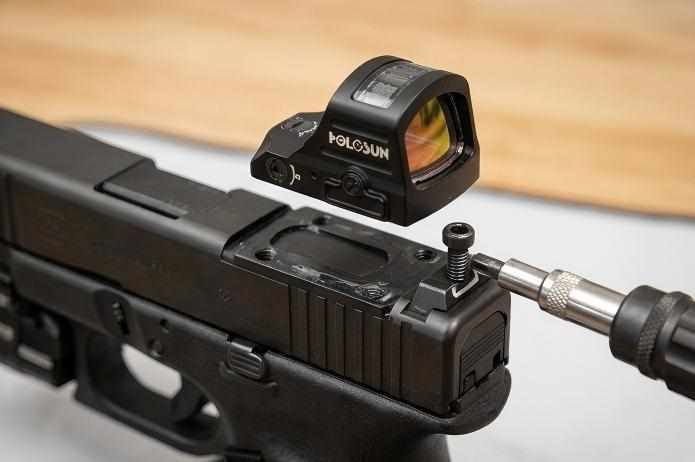
Why Can Removing a Red Dot Affect Its Zero?
Removing an optic does not automatically mean it will lose zero. The possibility of a shift depends largely on the mounting system and how consistently the optic is reinstalled.
Mounting Position
The optic needs to sit correctly against its mounting interface. Dirt, debris, or an inconsistent seating position can prevent it from returning to exactly the same position.
A clean and properly fitted mounting interface helps improve repeatability when the optic is installed again.
Mounting Torque and Interface
The way the optic is secured also matters. Mounting screws should be tightened according to the manufacturer’s specified procedure and torque requirements.
Using the wrong torque or tightening the screws inconsistently can affect how the optic sits on the mount. Different optics and mounts can have different specifications, so a universal torque value should not be assumed.
Accidental Adjustment During Maintenance
There is another simple possibility: the sight’s adjustment controls can be moved accidentally during removal, installation, or battery replacement.
If the adjustment turrets or controls are disturbed, the zero may change independently of the battery replacement.
How to Change the Battery in a Red Dot Sight Without Affecting Zero

The easiest way to preserve the existing mounting position is to replace the battery without removing the optic whenever the design allows it.
Side-Loading and Top-Loading Battery Designs
Side-loading and top-loading battery compartments are convenient because the battery can generally be accessed while the optic remains mounted.
When replacing the battery:
- Keep the optic securely mounted.
- Avoid touching the adjustment controls.
- Follow the manufacturer’s battery installation instructions.
- Make sure the battery is installed in the correct orientation.
- Close and secure the battery compartment properly.
Because the optic itself has not been removed, there is no need to disturb the mounting interface simply to replace the battery.
Bottom-Loading Battery Designs
Bottom-loading designs can require more care. If the battery cannot be accessed while the optic is mounted, the optic may need to be removed first.
After replacing the battery, reinstall the sight according to the manufacturer’s instructions. Do not assume that putting it back in approximately the same position guarantees the original zero.
Instead, verify zero before relying on the optic for precise shooting.
Side-Loading vs Bottom-Loading Batteries: Which Is Better for Zero Retention?
For battery replacement, side-loading and top-loading designs have a practical advantage because they allow the optic to remain mounted.
This reduces the number of times the mounting interface has to be disturbed and makes routine battery changes simpler.
However, battery location alone does not determine how well an optic holds zero. A well-designed bottom-loading optic with a reliable mounting system can also provide good zero retention.
When comparing red dot sights, it is therefore better to consider battery access as a maintenance and convenience feature, rather than treating it as a direct indicator of accuracy.
How to Check Whether Your Red Dot Still Holds Zero
If you replaced the battery without removing the optic, you generally do not need to automatically adjust the zero.

Still, it is reasonable to inspect the optic and mount for obvious movement or loose hardware. If anything appears different, the sight should be checked before further use.
If the optic was removed to replace the battery, zero verification is more important.
A basic check should include:
- Confirming that the optic is securely mounted.
- Checking that the reticle functions normally.
- Inspecting the mounting hardware.
- Verifying zero using an appropriate controlled shooting setup.
Avoid making adjustment changes simply because the battery was replaced. Adjustments should be based on an actual change in point of impact, not on the assumption that a new battery has changed the zero.
Conclusion
When the red dot sight is installed firmly, re-zeroing the battery is generally not necessary. The battery only provides illumination for the scale plate and does not affect the mechanical alignment.
However, if the battery needs to be replaced and the sight has to be removed, it’s a different story. After reassembling, there is a possibility of a slight offset in position, and re-zeroing is required.
If you frequently replace the battery, it is advisable to choose models with side-opening or top-opening battery compartments. This way, there is no need to remove the sight, and maintenance is more convenient. However, the stability of re-zeroing depends not only on the structure of the battery compartment but also on the sight itself, the clamping device, the installation process, and usage habits.