A red dot sight that feels perfect in a thick forest can become surprisingly limiting in an open meadow. The terrain changes how far you shoot, how quickly you spot game, how much light reaches your optic, and even which reticle is easiest to use.
That is why experienced hunters rarely ask, “What is the best red dot?” They ask a better question:
Where will I be hunting?
Whether you’re stalking deer through dense woodland or scanning open grassland for longer shots, choosing the right hunting red dot starts with understanding the environment – not simply comparing specifications.
In this guide, we’ll break down the real differences between dense woods and open fields, explain which optic features matter most, and help you choose a setup that matches the way you hunt.
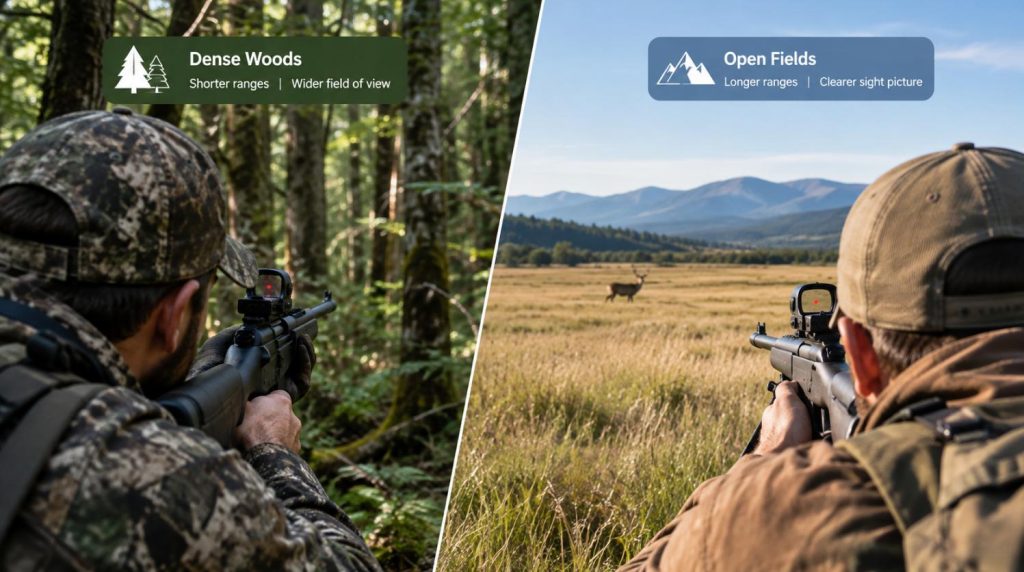
Why Hunting Environment Matters More Than Specifications
Many buyers compare MOA, battery life, or window size before thinking about where they’ll actually hunt. In reality, the environment has a much bigger influence on optic performance.
The same red dot can behave very differently because terrain changes visibility, shooting distance, and target movement.
| Environmental factor | Dense woods | Open fields |
| Typical shooting distance | Short to medium | Medium to long |
| Visibility | Trees and brush limit view | Wide, unobstructed view |
| Target movement | Fast, unpredictable | Easier to observe before shooting |
| Lighting | Shade and changing light | Bright daylight |
Instead of asking which optic is objectively better, it’s more useful to ask which optic solves the problems of your hunting environment.
Dense Woods Hunting: Prioritize Speed Over Distance
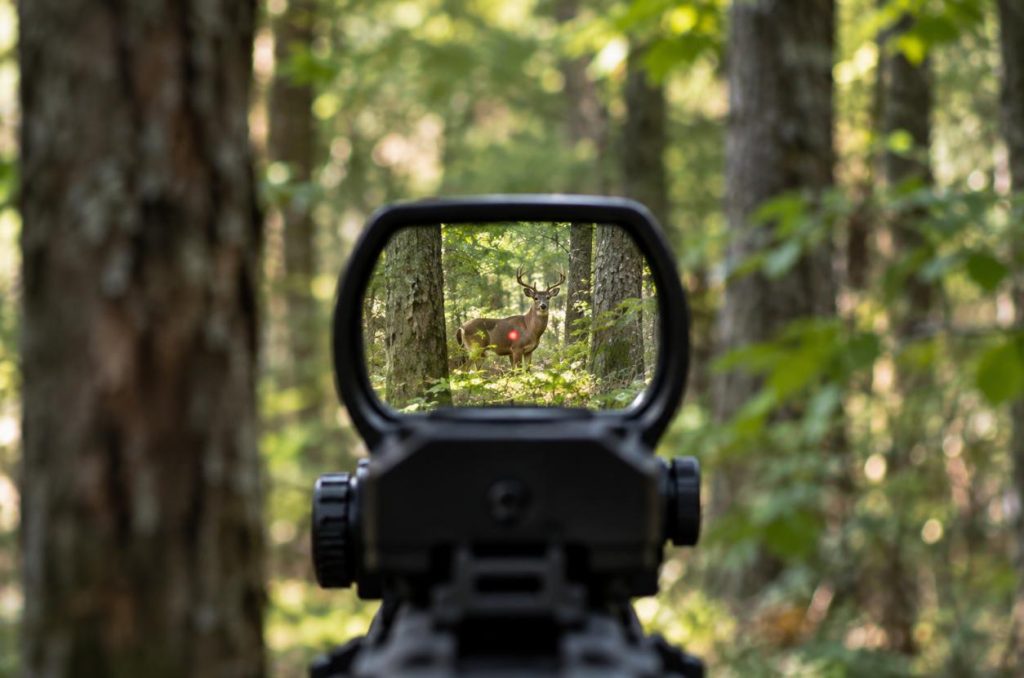
In thick woodland, opportunities often appear without warning. A deer may step between trees for only a few seconds, or a wild boar may emerge from heavy cover and disappear just as quickly.
This isn’t an environment where maximum magnification wins – it’s where fast target acquisition matters most.
The biggest challenges in woodland hunting
Dense forests create several limitations that affect optic choice:
- Trees reduce your field of view.
- Branches and brush constantly interrupt sight lines.
- Light changes dramatically between open patches and deep shade.
- Targets usually appear at relatively short distances.
Because of these conditions, hunters benefit more from seeing the target quickly than from making extremely precise long-range adjustments.
Features that work best in dense woods
| Feature | Why it helps |
| Large viewing window | Helps your eyes find the dot faster when game appears suddenly. |
| 3 MOA or Circle Dot | Easy to pick up quickly without covering too much of the target. |
| Adjustable brightness | Useful when moving between shaded forest and brighter openings. |
| Lightweight housing | Reduces fatigue during long walks or stalking hunts. |
A common misconception is that woodland hunting always requires the smallest possible dot. In reality, a slightly larger reticle is often easier to acquire when your target appears quickly between trees, especially at shorter hunting distances.
Open Fields Hunting: Precision Becomes More Important
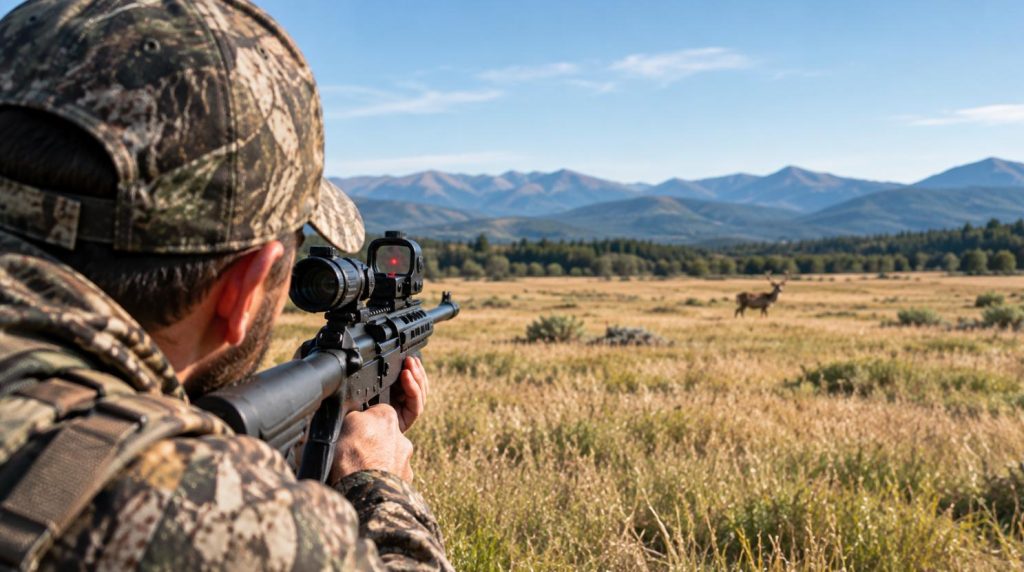
Open country changes the game completely. Instead of reacting instantly, hunters often have more time to observe movement, identify the animal, and prepare a stable shot.
The challenge is no longer finding the target – it’s placing the shot accurately.
What makes open terrain different?
Open fields usually offer:
- Longer shooting distances
- Consistent daylight visibility
- More time for careful aiming
- Better opportunities to identify game before shooting
Because targets occupy less of your field of view, reticle precision becomes more valuable than pure speed.
Features that work best in open country
| Feature | Benefit |
| 2 MOA dot | Covers less of the target at longer distances |
| High daylight brightness | Keeps the dot visible under strong sunlight |
| Clear optical glass | Makes target identification easier |
| Optional 3× magnifier | Helpful for identifying distant game, not essential for every hunt |
A magnifier is not a replacement for a rifle scope, but it can be useful when hunting across larger open landscapes where identifying the animal is just as important as aiming. Hunters often pair a red dot with a flip-to-side magnifier for this flexibility.
Comparing the Best Red Dot Setup for Each Environment
Now that we’ve looked at both environments separately, let’s compare the features that make the biggest difference.
Window Size: Wider Isn’t Always Better
The viewing window is one of the first things hunters notice, but its value depends on terrain.
| Window size | Best suited for |
| Large window | Dense woods, moving game, fast target acquisition |
| Medium window | Mixed terrain |
| Compact window | Lightweight mountain or stalking setups |
A larger window doesn’t increase accuracy – it simply makes it easier for your eye to locate the reticle quickly. That’s especially useful when shooting positions are less predictable in woodland environments.
Which Reticle Works Best?
This is where many hunters become overwhelmed by specifications. The truth is that no reticle is universally better – each solves a different problem.
| Reticle | Dense woods | Open fields |
| 2 MOA | ★★★★☆ | ★★★★★ |
| 3 MOA | ★★★★★ | ★★★★☆ |
| Circle Dot | ★★★★★ | ★★★☆☆ |
Choose 2 MOA if you:
- Hunt in open country
- Expect longer shots
- Want minimal target coverage
Choose 3 MOA or Circle Dot if you:
- Hunt deer or boar in woodland
- Need faster target acquisition
- Frequently shoot from standing positions
Rather than thinking in terms of “small vs large,” think in terms of speed vs precision.
Open or Closed Emitter: It Depends on Weather More Than Terrain
One of the fastest-growing discussions in the hunting optics market is open emitter vs closed emitter. The difference is real, but it is often misunderstood.
A closed emitter protects the internal light source from rain, mud, snow, and debris, making it a practical option for hunters who regularly face harsh weather. An open emitter, meanwhile, is often lighter and offers a simpler profile for everyday hunting in dry conditions.
| Hunting condition | Better choice |
| Dry woodland | Open or closed |
| Wet forest | Closed emitter |
| Snowy mountains | Closed emitter |
| Mild open fields | Either design works well |
The important takeaway is this:
Choose your emitter based on environmental exposure, not marketing trends.
Recommended Setups by Hunting Style
If you’re still unsure, this quick guide can help narrow your choice.
| Hunting style | Recommended setup |
| Deer in dense woods | Large window + 3 MOA + adjustable brightness |
| Wild boar at dawn | Circle Dot + high daylight brightness |
| Turkey with shotgun | Multi-reticle + wide viewing window |
| Mountain stalking | Compact lightweight red dot + 2–3 MOA |
| Open grassland hunting | 2 MOA + optional 3× magnifier |
For hunters looking for different configurations, Foreseen Optics offers a range of red dot sights including compact, open-emitter, and closed-emitter models suitable for different hunting environments. You can explore the collection here.
For distributors, outdoor brands, and importers, Foreseen also supports OEM red dot and wholesale red dot manufacturing with customizable reticles, logos, and mounting options.
Common Mistakes Hunters Make
Even experienced hunters sometimes choose an optic based on specifications alone. These are the mistakes that matter most in the field.
1. Choosing the smallest MOA for every hunt
A smaller dot is not automatically better. In dense woods, a slightly larger or circle reticle is often quicker to acquire.
2. Using maximum brightness all day
An overly bright dot can bloom and appear larger than it really is, especially in shaded environments. Adjust brightness to match ambient light whenever possible.
3. Ignoring window size
Many buyers focus on battery life but overlook the viewing window. In fast-moving woodland hunts, window size often has a bigger impact on speed.
4. Carrying unnecessary magnification
A magnifier adds weight and bulk. If most of your hunting happens inside dense forest, you may never need one.
5. Forgetting to confirm zero after transport
Even durable optics should be checked after long travel or rough handling. Verifying zero before a hunt is a simple habit that prevents missed opportunities.
Final Thoughts
The best hunting red dot isn’t determined by one specification – it’s determined by where you hunt.
If your season is spent moving quietly through dense woodland, prioritize fast target acquisition, a larger viewing window, and a reticle that’s easy to pick up under changing light. If your hunts take place across open fields, focus on precision, a smaller dot, and clear visibility in bright daylight.
Matching your optic to the environment will usually improve real hunting performance far more than chasing the newest feature.
Whether you’re selecting a sight for your own rifle or sourcing products as a distributor, choosing a red dot manufacturer that understands real hunting scenarios is just as important as choosing the optic itself. Foreseen Optics develops hunting red dot solutions for different terrains, weather conditions, and OEM requirements – helping hunters and brands find the right setup for every environment.