When many brands first inquire about binocular OEM services, their first question is: “Can you print our logo?” Of course—but a logo is only the most basic private-label service. It establishes brand recognition, yet by itself it cannot solve product homogenization, channel pricing, user experience, or batch-to-batch consistency.
A truly valuable telescope OEM/ODM project should begin with the target country, sales channel, end-use scenario, and expected retail price. The optical system, mechanical structure, appearance and handling, packaging and accessories, and quality standards should then be combined into a product solution that can be mass-produced. For importers, wholesalers, and outdoor brands, this is the key to building a lasting product advantage.
Why Does “Printing a Logo” Not Equal Genuine Product Customization?
A Logo Builds Recognition but Does Not Create Differentiation by Itself
If two brands use the same optical platform, rubber armor, accessories, and similar packaging, changing only the logo on the body quickly reduces the end market to price comparisons. This is especially true in e-commerce and wholesale channels, where consumers cannot see what justifies the premium and dealers struggle to give a clear reason for recommending one product over another.
A mature OEM customization program should answer four questions: What differences can consumers see? What differences can they feel in use? How can channel sales staff explain those differences? And how can the factory reproduce them consistently in mass production? Only when all four are addressed does customization progress from simple relabeling to genuine product development.
Level 1: Brand Identity, Colors, and Private-Label Packaging
Logos Can Appear Across the Product, Accessories, and Retail System
Common options include laser engraving or screen printing on the body, metal nameplates, raised or recessed lettering in the rubber armor, and branding on the focus wheel, lens caps, strap, soft case, EVA case, and cleaning cloth. For volume orders, model naming, serial numbers, EAN/UPC barcodes, shipping marks, and anti-counterfeit labels can also be standardized to improve warehousing, after-sales service, and channel traceability.
Colors and Surface Textures Are Also Part of the Brand Language
Rubber color, housing finish, focus-wheel accent color, grip texture, and nameplate material can all be adjusted to suit channel positioning. Birdwatching products, for example, often use muted greens or grays; travel retail benefits from brighter, easily recognizable colors; and hunting or all-weather outdoor products typically emphasize low reflectivity, slip resistance, and stain resistance. Color selection must also account for color-variation control, rubber aging, oil migration, and consistency across batches.
Packaging Customization Is More Than Redesigning the Color Box
Complete private-label packaging can cover color-box structure, gift-box or EVA options, inserts, manual language, warranty cards, certificates of conformity, importer information, warnings, outer-carton labels, and accessory lists. For the EU retail market, brands should also verify the applicable product-safety, responsible-party, and warning-information requirements for the product and sales method; see the European Commission product safety page.
Level 2: What Can Be Customized in the Optical System?
Magnification and Objective Diameter Are Only the Starting Point
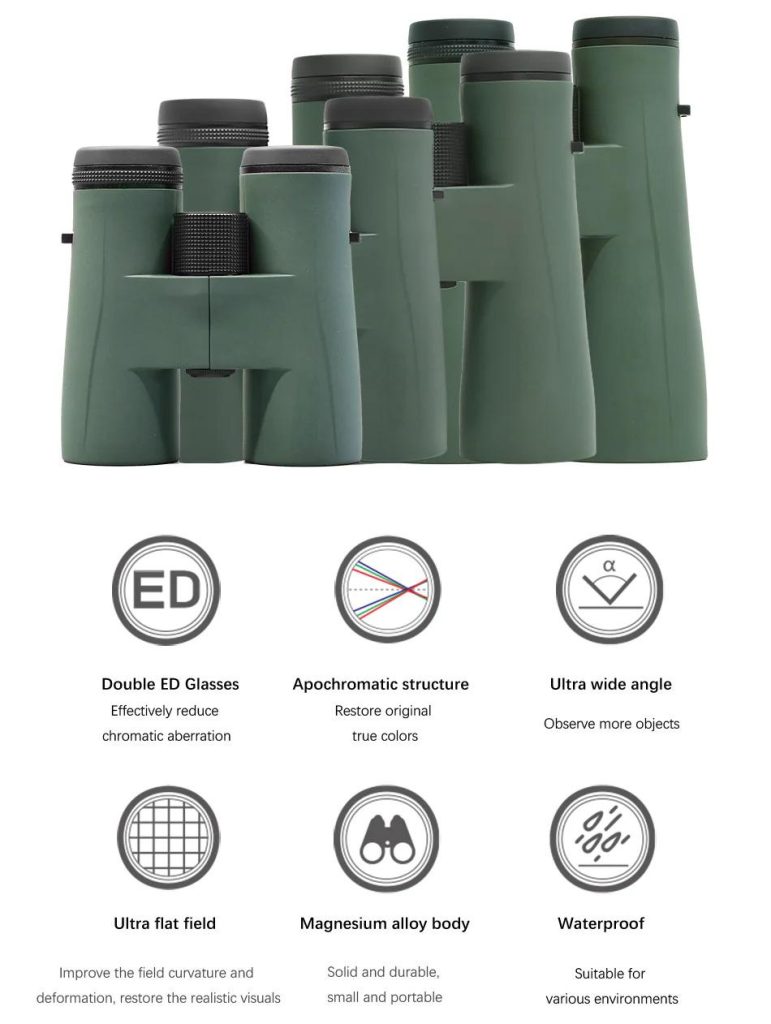
Optical customization can cover magnification, effective aperture, roof- or Porro-prism architecture, BK7 or BaK-4 prisms, ED low-dispersion glass, lens-group design, eyepiece field of view, close-focus distance, eye relief, diopter range, and edge performance. Brands should define the use case first and then prioritize specifications, rather than packing every high-end term into a single product.
For example, birdwatching channels typically value a wide field of view, fast focusing, color fidelity, and long eye relief; hunting channels focus more on low-light recognition, fog resistance, and structural reliability; and travel channels place greater emphasis on size and weight. For more on the trade-offs between roof and Porro designs, see “Roof Prism or Porro Prism”.
Coating Options Determine Brightness, Contrast, and Cost Positioning
Customizable options include single- or multilayer anti-reflective coatings, fully multi-coated (FMC) optics, phase-correction coatings on roof prisms, high-reflectivity dielectric coatings, silver coatings, hydrophobic and oleophobic coatings, and decorative coatings in specified colors. For B2B buyers, the key is not merely to specify “FMC,” but to confirm which optical surfaces are treated, how production units perform in transmission, and whether coating color and reflectivity remain stable from batch to batch.
Level 3: Mechanical Structure, Grip, and Operating Experience
Body Materials and Bridge Design Affect Weight, Durability, and Cost
Structural customization can cover bodies made from engineering plastics, aluminum alloy, or magnesium alloy; conventional center-hinge, open-bridge, or dual-hinge folding designs; and different wall thicknesses and reinforcing-rib configurations. For products used frequently outdoors, the design must also account for optical-axis stability after drops, hinge life, sealing space, and serviceability.
Rubber Armor Is Not Decoration but a Long-Term Reliability Component
Rubber compound, hardness, thickness, texture, armor boundaries, bonding process, and aging resistance can all be adjusted. Good armor should provide grip, comfort, low odor, and temperature resistance, without becoming sticky, separating, discoloring, or leaching oil during long-term storage or in high-temperature environments. For brands, these issues often affect return rates more directly than specifications on paper.
The Focus Wheel, Eyecups, and Hinges Define the Everyday User Experience
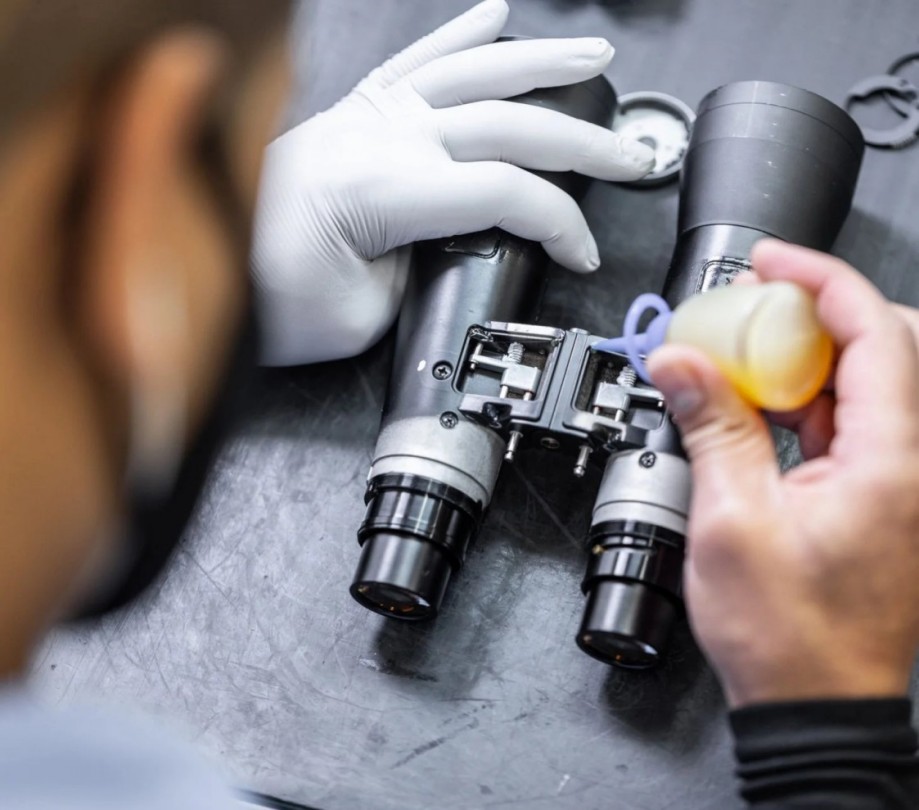
Focus-wheel diameter, knurling, resistance, travel, and feel at low temperatures; the click stops, play, and locking feel of twist-up eyecups; and the opening resistance of the center hinge can all be tuned during sampling. Whether eyeglass wearers can see the full field of view, whether the binoculars can be focused quickly with one hand, and whether controls remain easy to operate with gloves are all user-experience metrics worth defining in the OEM specification.
Level 4: Accessories and Channel-Specific Kits Can Also Differentiate the Product
Accessories Should Match Channel Use Cases, Not Simply Increase Item Count
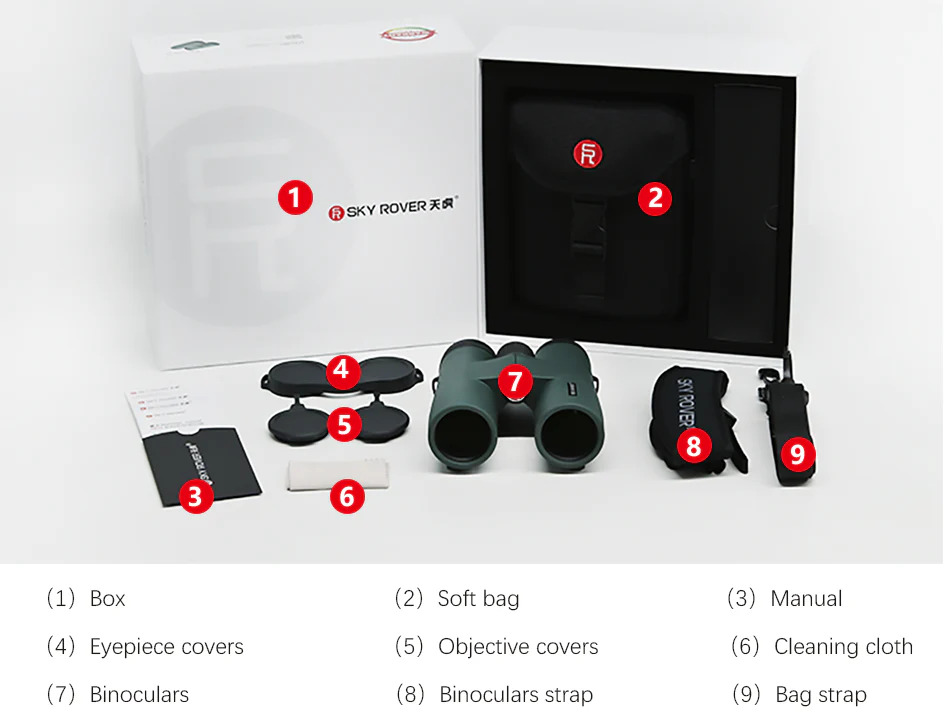
Common accessories include lens caps, straps, soft cases, hard EVA cases, cleaning cloths, binocular harnesses, floating straps, tripod adapters, and smartphone digiscoping adapters. Birdwatching channels may value comfortable straps and quick-access cases; travel kits prioritize low weight and compact storage; and large-aperture or astronomy products should prioritize a tripod interface.
For wholesalers, the accessory package also directly affects package dimensions, shipping costs, shelf presentation, and target retail price. One genuinely useful accessory usually provides a stronger reason to buy than three low-value giveaways and saves customers from having to make another purchase after delivery.
Level 5: Quality Standards and Acceptance Methods Also Need Customization
Brands Need More Than a “Great Sample”—They Need Consistent Mass Production
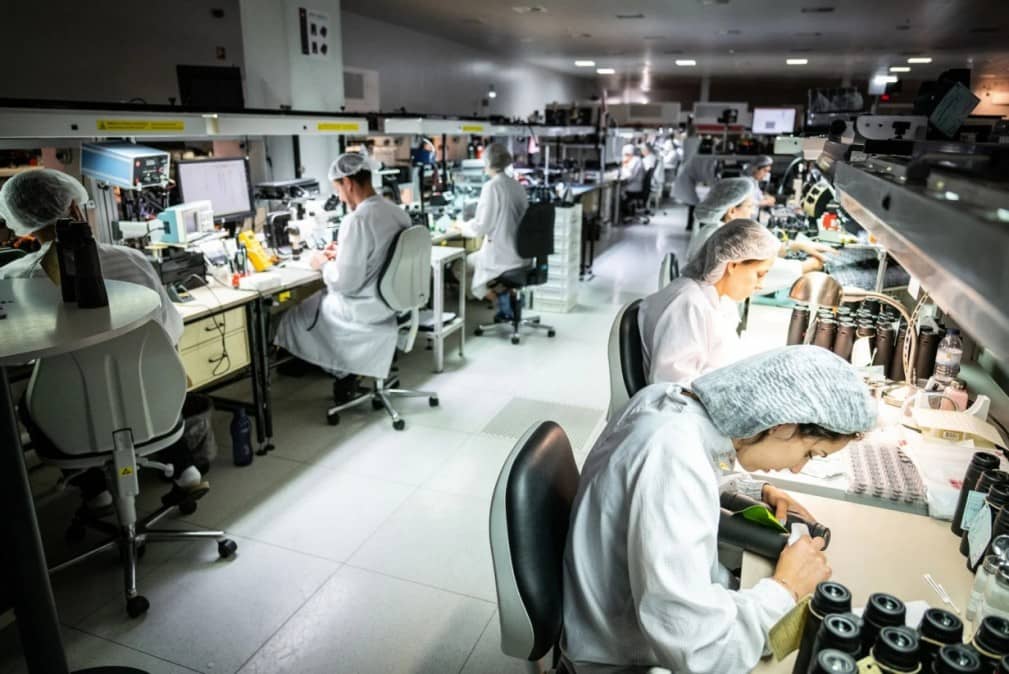
Before mass production, a golden sample, approved-sample records, a list of critical materials, and permitted tolerances should be established. Inspection items may include appearance, optical-axis alignment, resolution, field of view, focusing resistance, diopter adjustment, eyecup positions, nitrogen filling, waterproofing, temperature cycling, drop and vibration tests, and post-transport reinspection. Products at different price points may use different standards, but the acceptance criteria must be explicit.
A factory quality-management system can follow the process-based approach of ISO 9001. However, system certification does not automatically mean that a particular binocular meets a specified performance level. Brands must still define their critical user-experience requirements, test conditions, sampling rates, AQL rules, and procedures for nonconforming batches in purchasing documents.
Test Equipment and Record-Keeping Determine Whether Problems Can Be Traced
For mid- to high-end products, suppliers should be required to retain records for incoming materials, assembly, collimation, airtightness, and final inspection, and to trace critical materials by batch or serial number. When an after-sales issue occurs, only data can help the brand determine whether the cause is an isolated assembly defect, shipping damage, or a systematic deviation in a material batch or process.
How Do Different OEM Depths Affect MOQ and Development Investment?
Deeper customization generally involves more dedicated materials, production-run minimums, tooling, sampling rounds, and validation time. MOQ is not merely a supplier’s sales threshold; it is often shaped by coating-batch sizes, custom rubber colors, injection-molding quantities, packaging-print minimums, and production-line changeover costs. Brands should choose an appropriate level of customization based on expected first-order sales and channel certainty.
| Customization Level | Customizable Content | Best Suited For | Investment and Risk Profile |
| Rapid Private Label | Logo, model number, color, retail box, manual, barcode, and accessory bundle | Market trials, promotional-gift projects, and regional wholesalers | Relatively accessible MOQ and fast launch, but limited differentiation |
| Platform Configuration | Coatings, prisms, ED glass, eyecups, rubber armor, resistance, waterproofing, and kits | Brands and importers with established channels | Requires sample iterations; can create clearer selling points |
| Appearance and Structure | Bridge, body, armor texture, focus wheel, housing, and dedicated tooling | Growing brands seeking a distinctive visual identity | Higher tooling and validation investment; requires sales volume |
| In-Depth ODM Development | New optical system, mechanical platform, rangefinding or electronic functions, and complete product definition | Brands with stable channels, technical requirements, and medium- to long-term plans | Longest development cycle and highest resource commitment; requires rigorous project management |
What Information Should Brands Prepare Before Requesting a Quote?
A clear RFQ can significantly reduce back-and-forth communication and help suppliers provide more reliable proposals and quotations. At a minimum, prepare the following:
- Target countries, sales channels, and primary use cases;
- Target retail price, landed cost, or purchasing budget range;
- Highest-priority requirements for optics, weight, field of view, waterproofing, or operation;
- Benchmark competitor models, physical samples, or clearly defined strengths and weaknesses;
- Initial order quantity, annual forecast, and acceptable MOQ;
- Requirements for logo, colors, packaging, accessories, manual language, and barcodes;
- Test standards, target launch date, and compliance requirements in the sales region.
FORESEEN OPTICS provides rapid customization of proven platforms, solution matching, and in-depth development for different project stages. Brands can first review the Binocular Wholesale and Customization page, then explore roof-prism binoculars, Porro-prism binoculars, compact binoculars, or rangefinding binoculars.
Conclusion: Good OEM Customization Translates Market Demand into a Manufacturable Product
Telescope OEM customization may start with a logo and packaging, but it should not stop there. Optical configuration determines viewing performance; mechanical structure determines usability and durability; accessories and packaging shape channel presentation; and quality standards determine production consistency. For private-label brands, real competitiveness comes from aligning these elements as a system, not from adding one impressive specification in isolation.
To evaluate an existing product, plan a private-label program, or launch a binocular ODM project, submit your target specifications and purchasing plan through the FORESEEN OPTICS contact page.