Search for a red dot sight and you will find two familiar claims: “red dots are parallax-free,” and “every optic has some parallax.” Both are half true, and that half-truth is why this question keeps coming back.
A red dot is designed to keep the aiming point aligned with the target even when your eye is not perfectly centered behind the optic. Under normal viewing conditions, residual parallax can be small enough to have little practical effect.
But “parallax-free” does not mean zero parallax at every distance and every eye position. It is better understood as a design intent within a defined operating range.
The useful question is therefore not simply whether a red dot has parallax, but where the design performs as intended—and where residual error starts to matter.
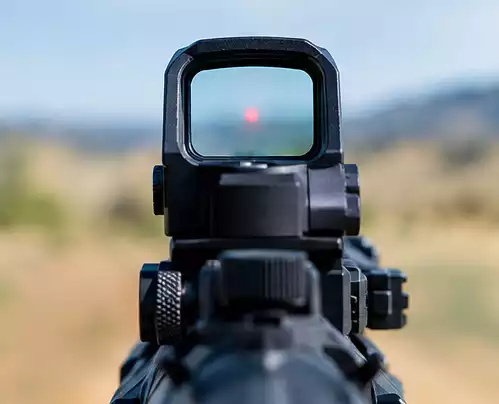
Do Red Dot Sights Have Parallax?
Yes, with an important qualification.
A red dot sight is designed so the aiming point remains stable when the shooter’s eye moves within the intended viewing area. This effect is strongest around the centre of the optical window.
As the eye moves farther toward the edge, the apparent position of the dot can change relative to the target.
So when a manufacturer describes a sight as “parallax-free,” the term should not be interpreted as a guarantee of zero movement from every possible viewing position.
The practical distinction is simple:
- Centre of the window: the optical system is generally at its most stable.
- Near the window edge: residual parallax can become more noticeable.
- Extreme off-axis viewing: the apparent movement can become easier to detect.
How Parallax Actually Works in a Red Dot Sight
The Dot Is Collimated—and That Is Why This Feels Confusing
What you see is not simply the image of a small lamp inside the optic.
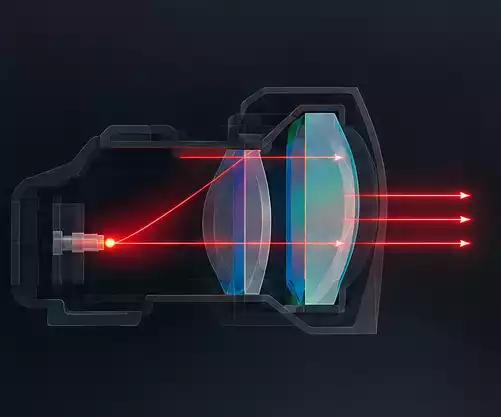
The emitter and optical system produce a collimated beam—light arranged so the dot appears to originate from a very distant point.
This is why the dot appears to stay in place when you move your head instead of behaving like a physical front sight.
The optical system is designed to keep the apparent position of the dot stable relative to the target as the viewing angle changes within the intended operating zone.
The important point is that this stability depends on the optical geometry and alignment of the system.
Parallax, Parallax Error, and POI Shift Are Not the Same Thing
These terms are often used interchangeably, but they describe different things.
| Term | What It Means |
| Parallax | The optical phenomenon where the apparent position of the aiming point changes with eye position. |
| Parallax error | The resulting angular displacement caused by that effect. |
| POI shift | A change in where the projectile actually impacts the target. |
POI shift can have many causes, including parallax, mounting movement, zeroing, ammunition, or shooting position.
Mixing these three up is how a technical discussion becomes confusing. They are different problems with different causes.
What “Parallax-Free” Really Means—and What It Doesn’t
“Parallax-free” does not mean no parallax anywhere.
It means the residual error is small enough that it should not create a meaningful aiming problem within the distances and eye positions for which the sight was designed.
That makes “parallax-free” a performance condition rather than an absolute physical property.
Parallax-Free at What Distance?
Distance changes the practical consequence of an angular error.
A small angular difference may produce little visible displacement at a short distance. The same angular difference produces a larger linear displacement farther away.
The angle did not change. The consequence did.
This is why parallax should be evaluated at the distance where the sight will actually be used.
Where the Window Edge Becomes the Problem
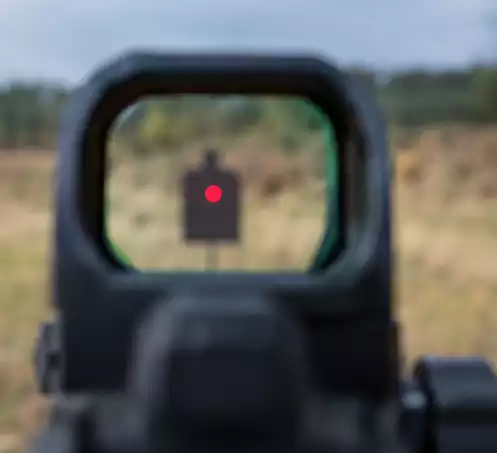
The centre of the viewing window is generally the optical sweet spot.
As the eye moves toward the edge, the viewing angle becomes more extreme. Optical geometry and manufacturing tolerances can then have a greater effect on the apparent position of the dot.
A larger window gives the shooter more usable eye position, but it does not make every point within that window optically identical.
Factors That Affect Parallax Performance
Optical Geometry: Focal Length, Lens Curvature, and Window Size
Window size, lens curvature, and focal length establish the optical envelope of the sight.
A larger window gives the designer more room to manage off-axis viewing and gives the shooter more room to position the eye.
However, window size alone does not determine parallax performance. The lens and emitter have to work together as one optical system.
Emitter-to-Lens Alignment and Collimation Tolerance
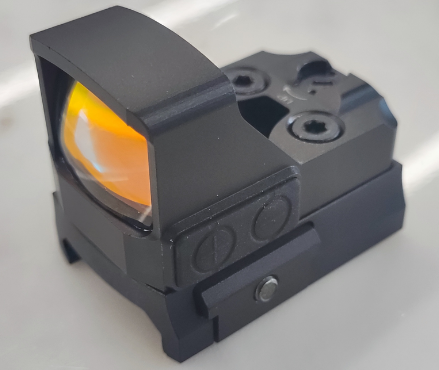
The emitter needs to remain in the intended relationship with the optical axis.
Even small alignment changes can affect the apparent position of the aiming point. This makes emitter alignment a mechanical concern as well as an optical one.
The final performance therefore depends on more than the optical design. The manufacturing and assembly process must reproduce the intended geometry consistently.
Viewing Angle, Eye Position, and Cheek Weld
Eye position is part of the sighting system.
A consistent cheek weld helps keep the eye within the area where the optical design is intended to perform.
This becomes more important when shooting from unconventional positions. Moving farther off-axis can expose residual parallax that is difficult to notice through the centre of the window.
When Parallax Becomes Noticeable

Close Range
Parallax does not necessarily grow at close range. Your margin shrinks.
A small angular error may correspond to a relatively small displacement at short distance. As distance increases, the same angular relationship can produce a more noticeable shift.
Behind a Magnifier
A magnifier changes how the red dot is viewed.
If residual movement exists in the red dot, magnification can make that movement easier to see. The magnifier does not automatically remove the underlying optical relationship.
The complete red dot and magnifier setup should therefore be considered as a system.
High Mounts and Awkward Positions
Mounting height can affect how easily the shooter finds the intended viewing position.
A higher optic may require more head movement to establish a natural sight picture. In awkward positions, this can increase the chance of viewing the dot away from the optical sweet spot.
A high mount does not automatically create parallax. It can simply make off-axis viewing more likely.
How to Check Parallax on Your Own Setup in 30 Seconds
A simple test can help you see whether residual parallax is noticeable in your setup.
- Secure the optic. Rest the rifle so it cannot move during the test.
- Choose a small, distant target. Pick a fixed point that is easy to identify.
- Look through the centre of the window. Note the relationship between the dot and target.
- Move your head slowly. Move your eye toward different edges of the window without moving the optic.
- Watch the dot. If it stays essentially aligned with the target, the sight is behaving as intended. If it visibly moves away from the target, you are seeing residual parallax.
Perform the test at a distance that represents your actual use.
A short-range bench test can show whether movement is obvious at that distance, but it does not necessarily predict performance farther downrange.
How Parallax Is Controlled in Design and Manufacturing
Parallax performance begins with optical design, but it does not end there.
The emitter, lens, housing, and mounting structure have to maintain their intended relationships through machining and assembly.
Designing the Optical System for Low Parallax
The optical system is designed around the relationship between the emitter, lens, window, and optical axis.
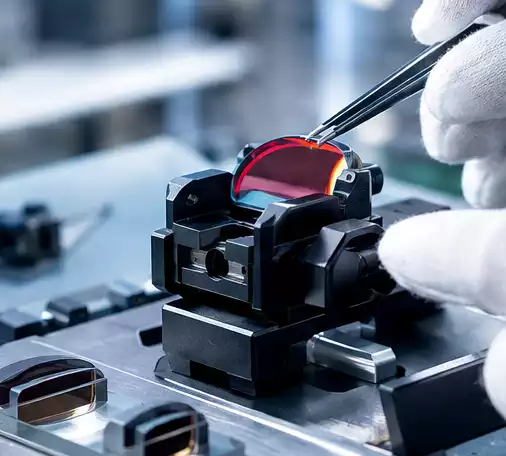
Optical design and mechanical assembly sit in the same company. Our 2018 move into our Nantong CNC and assembly line put them under one roof—allowing optical requirements and manufacturing requirements to be considered together.
Holding Alignment Through Assembly
A design only matters if production can reproduce it.
Critical components need controlled dimensions, defined reference points, and appropriate inspection methods.
We hold part dimensions with gauges rather than visual judgement, with calibrated instruments used on the production floor.
The goal is not simply to produce components to a drawing. It is to maintain the relationships that the optical design depends on.
Verifying Before It Ships
Quality control should close the loop between production and the finished optic.
Every unit is inspected, and finished goods can be traced back to raw material by batch, supported by a documented complaint loop and recall procedure.
Material is also a build-sheet decision, not a catalogue default. Size, graphic, and material replacement are specification items defined according to the project.
We would rather show you design files and gauge records than promise a number we have not measured.
Final Thoughts
Parallax-free is a design intent. What matters is knowing where the design stops being effectively parallax-free—and whether the people who built it know that too.
If you are re-specifying an optic, send us your current drawing. We will tell you what can stay, what has to change, and what needs verifying first.
FORESEEN Optics · Written by the Engineering Team
FAQ
Do Red Dot Sights Have Parallax?
Yes, residual parallax can exist even though red dots are designed to minimize it within the intended viewing area. It is generally more noticeable when the eye moves toward the edge of the window.
Are All Red Dot Sights Parallax-Free?
No. Optical architecture, window geometry, lens design, emitter alignment, and assembly quality can all affect practical parallax performance.
Do Red Dots Need Parallax Adjustment?
Generally, no. Parallax adjustment is more commonly associated with variable-magnification optics, which use a different optical arrangement.
Why Does My Dot Move When I Move My Head?
First check whether your eye has moved outside the effective viewing area, whether the window is obstructed, or whether the optic or mount has moved. Dot movement does not automatically mean the optic has a mechanical fault.
Does Parallax Matter at 100 Yards With a Red Dot?
It can become more relevant as distance increases because the same angular error can produce a larger displacement on the target. Adding magnification can also make residual movement easier to observe.