A durable red dot sight housing is not defined by one material specification or one impressive test number. It is the result of several decisions working together: how the housing handles load, how its geometry distributes stress, which alloy is selected, how accurately it is machined, how the surface is protected, and how the final assembly is controlled.
A red dot sight housing does not fail simply because someone picked the “wrong” alloy. It fails when one link in that chain runs out before the others.
Ask whether 7075 is better than 6061, and you get a specification sheet. Ask where a housing is most likely to fail, and you get a much more useful engineering question.

What Actually Breaks a Red Dot Sight Housing?
Before discussing materials or machining, it is worth looking at what the housing actually has to withstand. In real use, durability is rarely about one isolated event.
Drop and Impact
A drop can put a concentrated shock load into a relatively small area of the housing. If the optic lands on a corner, mounting area, or another hard contact point, the load is not distributed evenly across the structure.
The optic takes the hit the rifle does not. A fall onto a rail corner can turn a short impact into a very high local load. This is why impact resistance depends on more than simply making the housing thicker.
Recoil Impulse, Over and Over
One impact is only part of the story. Repeated recoil introduces a different problem: fatigue.
A housing may survive an individual shock but still develop problems after thousands of repeated load cycles. Over time, small weaknesses in corners, transitions, mounting points, or other stress concentrations can become more important than the overall strength of the material.
One shot tells you very little. Repeated loading is what eventually finds the weak point.
Mount Torque and Clamp Squeeze
The mounting interface creates another source of mechanical load. Rail clamps, screws, and mounting bosses all transfer force into the housing.
Excessive or uneven clamping can create localized stress and, in some designs, contribute to deformation or alignment problems. A strong housing does not compensate for a poorly designed mounting interface.
Thermal Cycling, Moisture and Corrosion
Field durability is not only mechanical. Temperature changes, condensation, humidity, rain, and salt exposure can gradually affect the housing and its surface.
Corrosion is slow and often invisible at first. Over time, however, surface damage can affect appearance, wear resistance, and the protection provided by the finish.
That is why material selection and surface treatment have to be considered as part of the same durability system.
How Housing Design Affects Durability

Material strength matters, but the way that material is shaped often matters just as much.
Geometry and Load Distribution
Load does not travel where you want it to. It travels where the structure allows it to.
Corners, transitions, radii, ribs, and the way different sections meet all influence how stress moves through a housing. A well-designed structure spreads a load across a wider area instead of allowing it to concentrate at one vulnerable point.
This is one reason two housings made from the same alloy can behave differently under the same load.
Wall Thickness and Stress Concentration

Thicker is not automatically stronger.
Adding material can increase stiffness, but beyond a certain point, extra thickness may add weight without solving the actual failure mechanism. If the critical stress is concentrated at a corner, transition, or mounting feature, simply making the surrounding wall thicker may not address the problem.
Good housing design puts material where the load requires it rather than making every section unnecessarily heavy.
The Mount Interface
The rail clamp, screw bosses, and recoil-related interfaces deserve particular attention because they connect the housing to the outside load path.
A housing can be extremely robust as a standalone part and still become a weak system if the mounting interface is poorly designed.
For buyers, this means a red dot sight housing should not be evaluated as an isolated shell. The housing, mounting structure, and load path have to work together.
Enclosed Versus Open Housings
Enclosed and open housing architectures solve different problems.
An enclosed housing can provide greater protection around the optical components and can make environmental sealing more straightforward. An open design can reduce weight and provide a wider peripheral view.
Neither is automatically the more durable option. The right architecture depends on the intended application, environmental exposure, weight target, and how the internal components are protected.
How Material Selection Balances Strength and Weight
For many red dot sight applications, aluminum offers a practical balance between strength, weight, machinability, and surface treatment.
Polymer can also make sense in applications where low weight and cost are priorities and the expected mechanical demands are more moderate. The important question is not which material sounds strongest on paper, but whether the material matches the complete design.
Why Aluminum Dominates
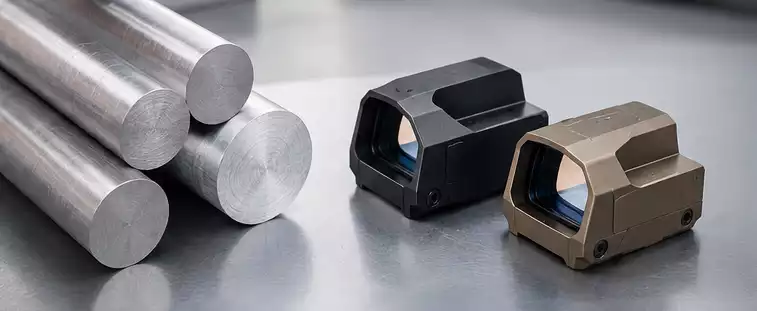
Aluminum combines useful strength-to-weight performance with relatively straightforward machining and established surface-treatment processes.
For an aluminum red dot sight, the alloy is only one part of the equation. Geometry, wall distribution, mounting design, machining quality, and finishing can all change how the final housing performs.
6061 Aluminum: The Workable Default
6061 is widely used because it offers a practical balance of strength, machinability, cost, and finishing characteristics.
It is relatively easy to machine and generally provides predictable results during production. That makes it a sensible choice for many housing designs where the entire system does not require the higher strength associated with other aluminum alloys.
6061 should not be viewed as a compromise simply because a stronger alloy exists. The correct alloy depends on the requirements of the design.
7075 Aluminum: More Strength, More to Manage
7075 offers higher strength than 6061, but that does not automatically make it the better material for every housing.
Higher material performance can come with higher cost and different machining and finishing considerations. Its surface-treatment response also differs from 6061.
“7075, therefore better” is specification-sheet thinking rather than design thinking. The useful question is whether the additional material capability solves an actual requirement in the housing.
Strength, Weight and Cost
Every housing involves trade-offs between strength, weight, manufacturing complexity, and cost.
The best material is not necessarily the strongest one available. It is the one that provides enough performance for the intended load while fitting the weight and manufacturing requirements of the product.
Why Manufacturing Accuracy Decides Housing Performance
A good housing design only works if it can be reproduced accurately in production.
CNC Machining of the Features You Never See
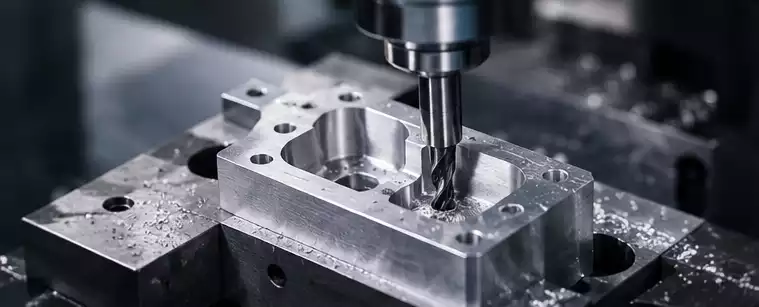
Some of the most important features are the ones a buyer may never notice visually: the bore where an optical component sits, the surface that interfaces with the mount, the pockets around internal components, and the geometry of mounting features.
The features that matter most are often the ones you never see. Get those wrong, and no alloy can compensate for the resulting design or assembly problem.
Dimensional Accuracy and Optical Alignment
The housing is part of the optical system, not simply a protective shell.
This is why a buyer may reasonably ask whether different configurations are built from the same basic structure. Two products that look similar externally can have different internal arrangements, mounting relationships, or optical requirements.
Mechanical accuracy matters because the housing ultimately has to hold the optical components in the intended relationship.
Surface Treatment and Long-Term Protection
Anodizing and other surface treatments contribute to wear and corrosion protection, but surface treatment is not a single universal process.
The result depends on factors including the alloy, treatment method, coating characteristics, and process control. When a customer requires a tougher corrosion or wear standard, the answer may involve changing more than the coating itself.
Material selection, surface treatment, and verification have to be considered as one system.
Assembly, Sealing and Purging
Manufacturing does not end when CNC machining is complete.
Sealing, O-ring selection, assembly sequence, torque control, and purging can all influence long-term reliability. A process only has value when it is controlled and verified.
At FORESEEN Optics, optical design and mechanical assembly sit within the same organization, bringing the manufacturing process closer to the teams responsible for the original design.
How to Verify Housing Durability Before You Buy
A supplier can say that a housing is durable. The more useful question is what evidence supports that claim.
Ask for the report number, not just the claim. A meaningful test should have documentation behind it.
Ask whether the sample passed or the production batch passes. A qualification sample and a production batch are not automatically the same thing.
Ask what counts as failure. If a supplier cannot clearly define what constitutes failure, it becomes difficult to understand what the test actually measured.
Ask about traceability. Raw material, production, finishing, and assembly should be traceable enough to investigate problems if they appear later.
On our side, finished goods can be supported by documented inspection, batch-level material traceability, and a defined complaint and recall process. We would rather provide records behind a durability claim than quote a number that cannot be traced to its source.

Conclusion
A durable red dot sight housing is not created by choosing one impressive material specification. It comes from keeping the entire chain working together:
Load → Geometry → Alloy → Machining → Surface Treatment → Assembly
A housing is durable when no single link in that chain gives up first.
That is also why evaluating a housing only by its alloy grade, wall thickness, or one test number can give an incomplete picture. The better question is whether the design, material, manufacturing process, and verification method all support the same durability target.
If you are developing a housing or evaluating an existing design, send us the drawing you are working from. We can identify what can stay, what may need to change, and what should be verified before anyone puts a durability number on the specification sheet.
FAQ
Is 7075 better than 6061 for a red dot housing?
Not necessarily. 7075 provides higher strength, but it also involves different cost, machining, and finishing considerations. The better choice depends on the housing design, expected loads, weight target, and intended application.
Does a thicker wall make a housing stronger?
Not automatically. Load distribution, geometry, and stress concentration can be more important than simply adding material. Excessive thickness can also increase weight without addressing the actual weak point.
Are aluminum housings as strong as steel?
Aluminum offers an attractive strength-to-weight balance, while steel provides higher density and different mechanical characteristics. The choice is a trade-off involving strength, weight, cost, and structural design rather than a simple ranking.
Does surface treatment really matter?
Yes. Surface treatment contributes to wear and corrosion protection, particularly when a product is exposed to moisture and environmental conditions over time. The result depends on the alloy and the treatment process.
How do I check a supplier’s durability claims?
Ask for test documentation, clarify whether the result applies to a sample or production batch, ask how failure is defined, and check whether the material and production process can be traced by batch.