Novice and experienced shooters often struggle with a question: “What red dot MOA is best?” The answer depends on your shooting scenario and usage requirements. A 2 MOA scale offers better accuracy in long-range shooting, while a 6 MOA large scale is more convenient for quickly capturing targets at close range. Nowadays, many optical sights support changing the scale size, allowing you to adapt to various scenarios without having to replace the sight, making it more flexible.
This guide will explain what MOA means, compare with the mainstream specifications, discuss other key factors that affect the user experience, and introduce the new variable MOA technology, helping you understand how to choose between 2 MOA and 6 MOA.
What Does MOA Mean on a Red Dot Sight?
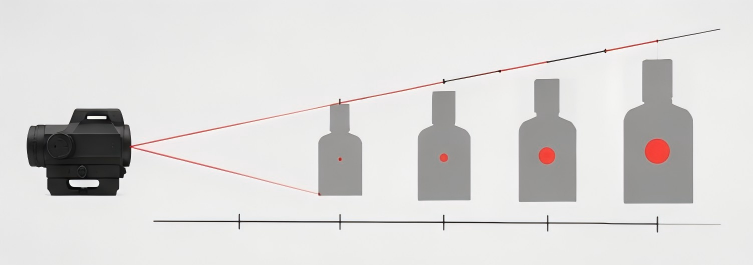
MOA stands for Minute of Angle, an angular measurement used to describe the size of a red dot. At approximately 100 yards, 1 MOA covers about 1 inch. As distance increases, the dot appears to cover a larger portion of the target.
For example:
- 2 MOA covers roughly 2 inches at 100 yards.
- 3 MOA covers about 3 inches at 100 yards.
- 6 MOA covers about 6 inches at 100 yards.
Note that a smaller MOA does not mean that the scope itself has higher accuracy; it simply means that the red dot’s blocking range is smaller, making it easier to precisely aim at long distances or small targets. Larger red dots have higher visibility and can quickly lock onto the target during rapid shooting.
Does a Smaller Dot Always Mean Better Accuracy?
Not necessarily.
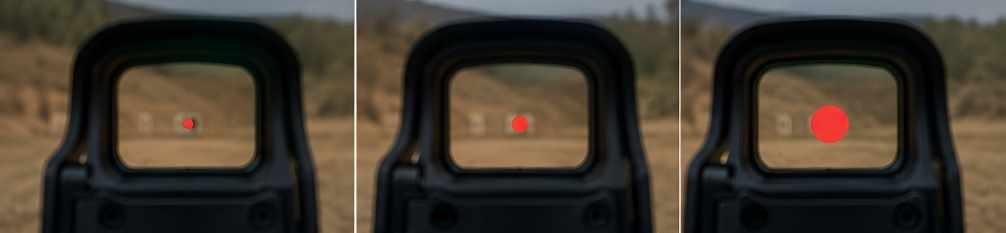
Many shooters mistakenly believe that a smaller aiming point leads to higher shooting accuracy, but the actual performance depends on the usage scenario.
A 2 MOA dot offers a finer aiming point, making it easier to hold on small targets or at extended distances. However, because it is smaller, it may take slightly longer to locate during fast target transitions.
A 6 MOA dot is much quicker to acquire, especially under stress, in low-light conditions, or when engaging multiple close-range targets. The trade-off is that it covers more of the target at longer distances.
The shooter’s skill level also matters. Experienced shooters can often use either dot size effectively, while beginners may find a larger dot easier to track and center during presentation.
Rather than obsessing over which aiming point “has higher accuracy”, it is better to choose the specification that suits your usual usage scenario and can consistently achieve good results.
Comparing 2 MOA, 3 MOA and 6 MOA
2 MOA: Best for Precision
A 2 MOA dot is popular among shooters who value precise shot placement.
Advantages
- Precise aiming at medium and longer distances
- Covers less of the target
- Well suited for target shooting and hunting
Considerations
- Slightly slower to acquire during rapid shooting
- May appear dimmer if brightness is set too low
3 MOA: A Balanced Choice
A 3 MOA dot strikes a balance between speed and precision, making it one of the most versatile options available.
Advantages
- Fast enough for defensive or competition use
- Precise enough for most recreational shooting
- Easy transition between short and medium distances
Best for
- General-purpose rifles
- Handguns
- Shooters who want one optic for multiple roles
6 MOA: Built for Speed
A larger 6 MOA dot is designed for rapid target acquisition.
Advantages
- Extremely easy to see
- Fast target acquisition
- Excellent for close-range engagements
Best for
- Defensive shooting
- Action pistol competitions
- Shooters with aging eyes or reduced visual acuity
Other Factors That Matter Besides Dot Size
While MOA is important, it should not be the only factor when choosing a red dot sight.
Window Size
A larger viewing window often makes it easier to locate the dot quickly and maintain awareness of your surroundings.
Brightness Adjustment
Look for optics with multiple brightness settings, including daylight-bright levels and lower settings that reduce glare in dim conditions.
Battery Life
Long battery life minimizes maintenance and reduces the risk of the optic shutting down during use. Features such as motion activation or automatic shutoff can further extend operating time.
Durability
A quality red dot should maintain zero under recoil and withstand rain, dust, and everyday impacts. Durable construction is especially important for duty, hunting, or competition use.
Mount Compatibility
Ensure the optic matches your firearm’s mounting footprint or that suitable adapter plates are available.
New Tech: Variable MOA Red Dots Solve the 2 MOA vs 6 MOA Dilemma
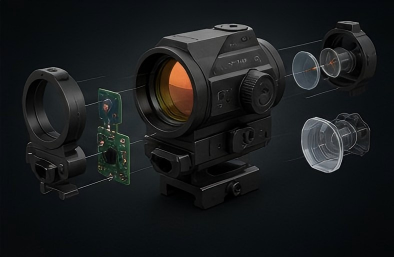
Why Shooters Struggle Between Small and Large Dots
For years, shooters have had to choose between a smaller dot for precision and a larger dot for speed. That decision isn’t always easy, especially if one firearm is used for multiple purposes.
For example, a competitor may need to engage close targets rapidly before transitioning to smaller targets at longer distances. Likewise, a recreational shooter may want one optic for both range practice and home defense.
Instead of choosing one compromise, many shooters are now looking for optics that offer greater flexibility.
How Variable MOA Technology Works
Some modern red dot sights allow users to switch between different reticle sizes or dot configurations within the same optic.
Depending on the model, you may be able to select a smaller dot for precision work and then switch to a larger dot—or a combined reticle—for faster target acquisition at closer distances.
This allows shooters to adapt the optic to different scenarios without replacing equipment or maintaining multiple red dots.
When Variable MOA Makes Sense
Variable MOA optics are particularly useful for shooters who regularly switch between different applications.
They can be a practical choice for:
- Multi-purpose rifles or handguns
- Competitive shooting with varied target distances
- Training across different shooting disciplines
- Shooters who want maximum flexibility from a single optic
Instead of owning separate optics optimized for different roles, one sight can handle a broader range of situations.
What to Look for in a Variable MOA Red Dot

Not all variable MOA systems perform equally. Before purchasing, consider the following:
- Reliable switching mechanism that changes reticles quickly and consistently
- Useful dot size options that match your intended shooting distances
- Consistent brightness across different reticle settings
- Clear optical performance with minimal distortion or emitter artifacts
- Proven durability and the ability to maintain zero after repeated use
Choosing a well-built optic is often more important than simply having additional reticle options.
Final Thoughts
For long-distance precise shooting, a 2 MOA crosshair would be an ideal choice; for close-range quick aiming, a 6 MOA one would be more convenient. If you want to cover multiple scenarios, a 3 MOA fixed crosshair is still a highly versatile specification.
If you often switch between different shooting environments, the new variable MOA crosshair is very practical. A single scope that can balance aiming speed and shooting accuracy at the same time, without having to sacrifice one for the other, offers greater flexibility for both beginners and experienced shooters.
In the end, the most suitable crosshair sight depends on your firearm, shooting habits, and the scenarios of your daily training.