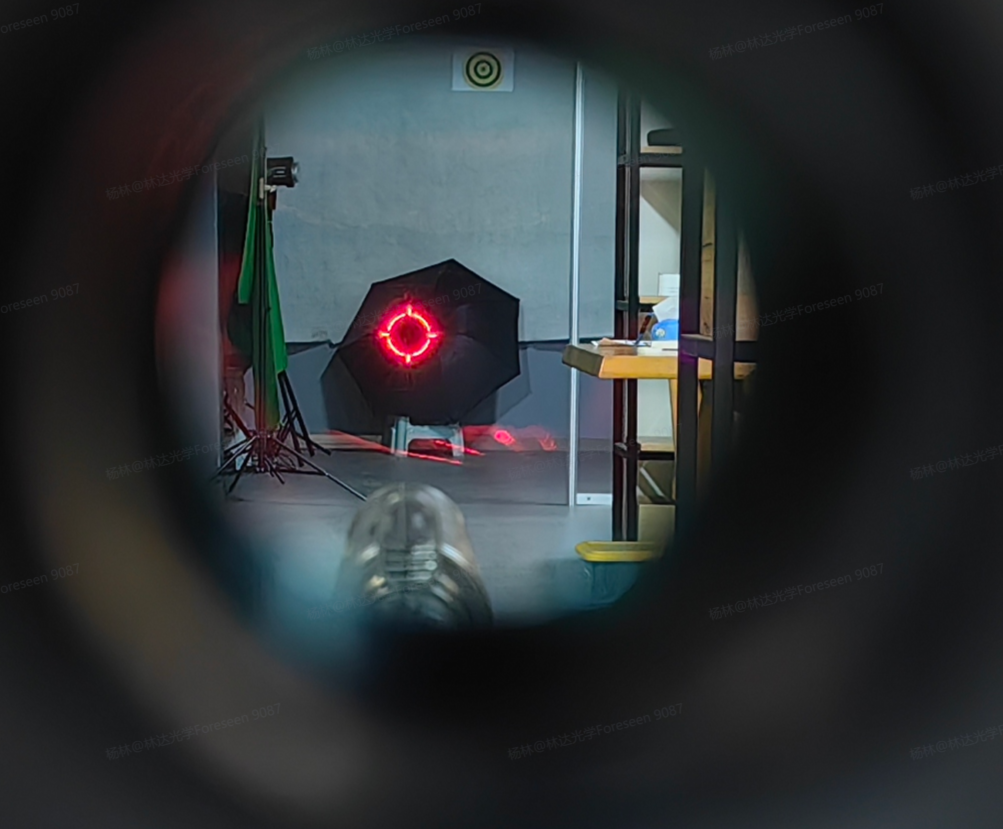
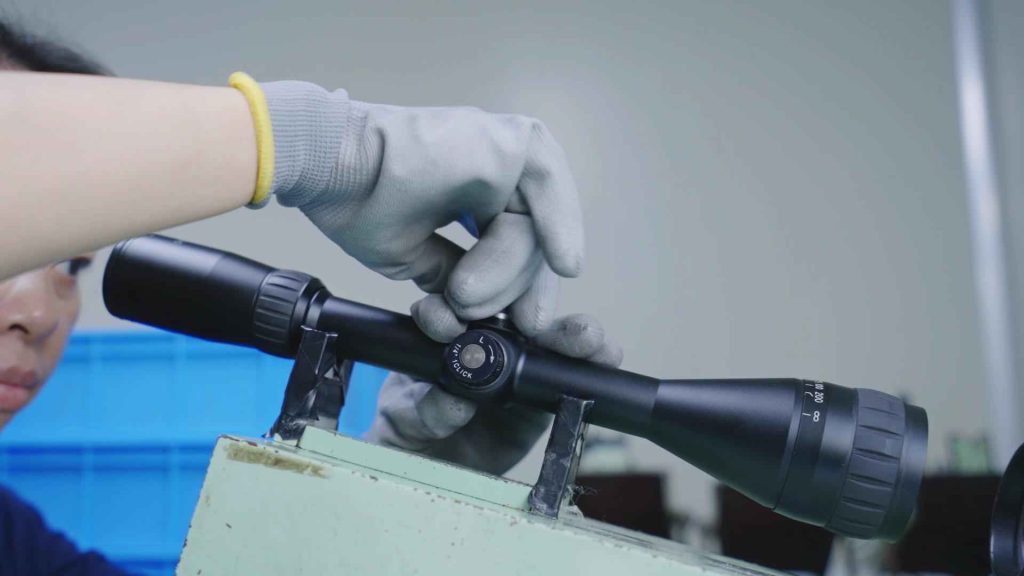
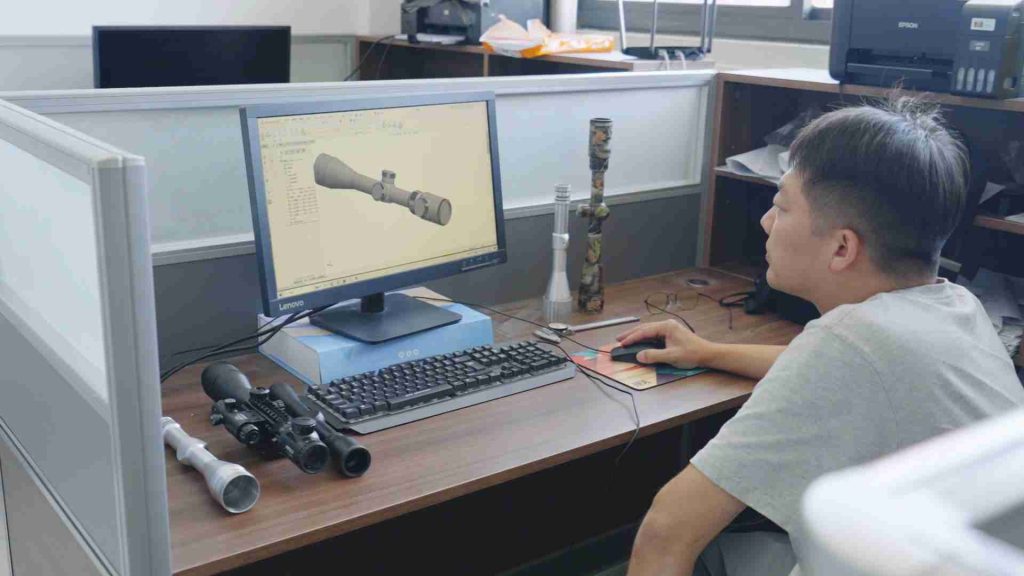
Since 2023, FORESEEN has invested in R&D and testing for high-zoom-ratio LPVO OEM projects such as 1–8× and 1–10× models. Working with established brand customers, we have finalized designs and produced samples. After customers receive those samples, we often hear a very specific comment:
“The lowest setting is labeled 1×, but why does the target look smaller through the scope than with the naked eye?”
Sometimes the customer goes further: “Does that mean the actual magnification does not reach 1×?”
This deserves a careful explanation. In most cases, a subjective sense of minification does not, by itself, prove that the manufacturer has misstated the magnification.
The key is that, for a wide-field LPVO, “1×” involves at least two different concepts: angular magnification at the center of the optical axis and the way the image is mapped across the entire field of view to the human eye.
They are not the same thing.
1. What does a nominal 1× actually mean?
In a telescopic system, magnification is not defined by whether the view “looks like” unaided vision. It is measured as angular magnification.
Put simply:
If a distant target subtends an angle θ to the naked eye and an angle θ′ to the eye after passing through the optical system, then:
M = θ′ / θ
If the measurement near the optical axis is:
M ≈ 1.00
Then, optically speaking, it is a 1× system.
ISO 14490-1 likewise lists angular magnification as a basic test for telescopic optical systems, measured separately from parameters such as field of view, exit pupil, and eye relief.
An LPVO can therefore deliver a true 1× at the center of the optical axis while the user still feels that:
“The whole image looks slightly smaller than it does to the naked eye.”
There is no contradiction here.
Vortex has also explained publicly that, even when an LPVO’s optical magnification really is 1×, the image formed through more than a dozen lens elements may still look different from unaided vision. The difference is usually more apparent toward the edge of the field. Vortex further emphasizes that diopter adjustment can substantially affect how close the lowest setting feels to a “true 1×.”
In other words:
1.00× is an optical measurement; “as natural as the naked-eye view” is an experience delivered by the whole system.
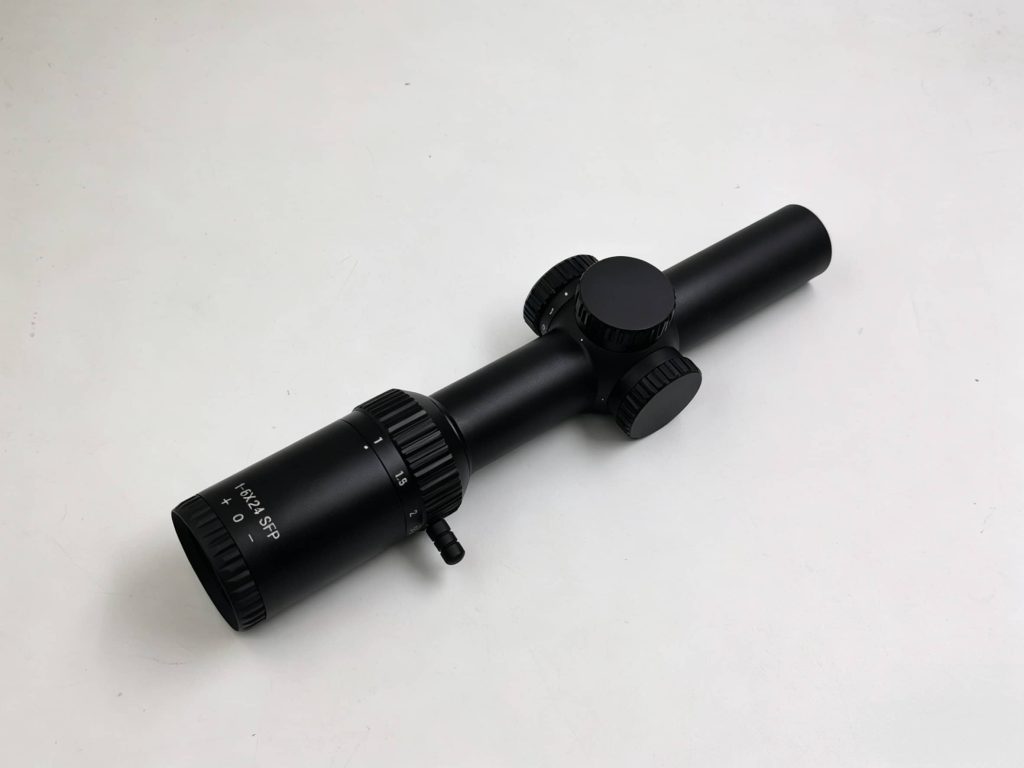
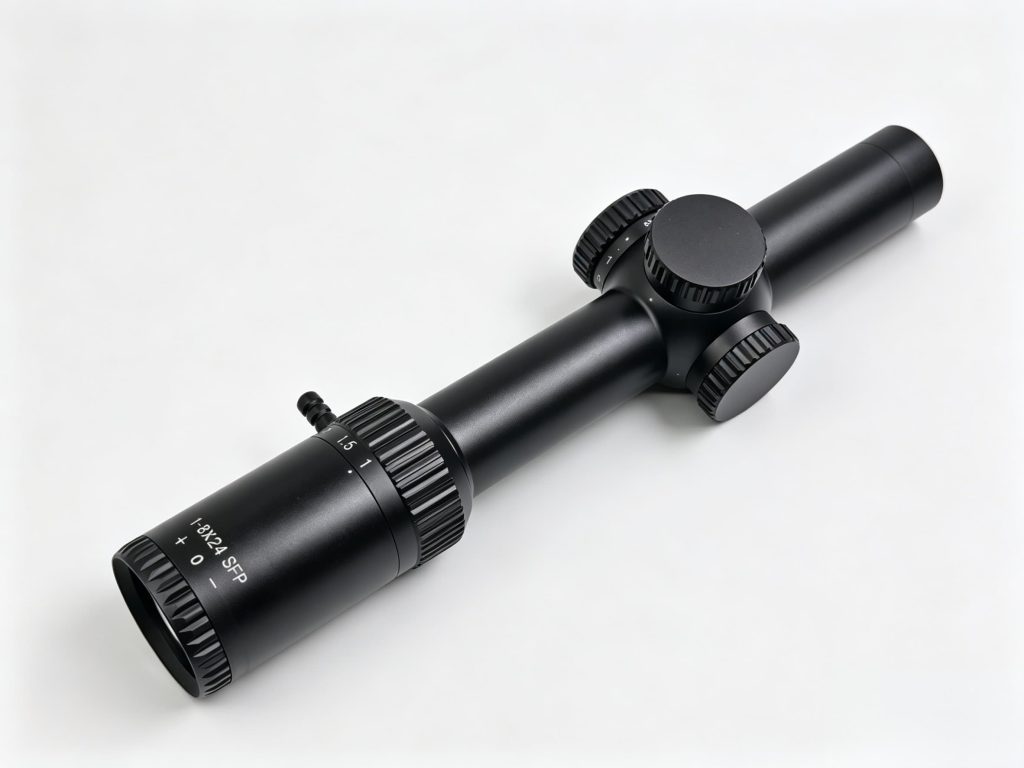
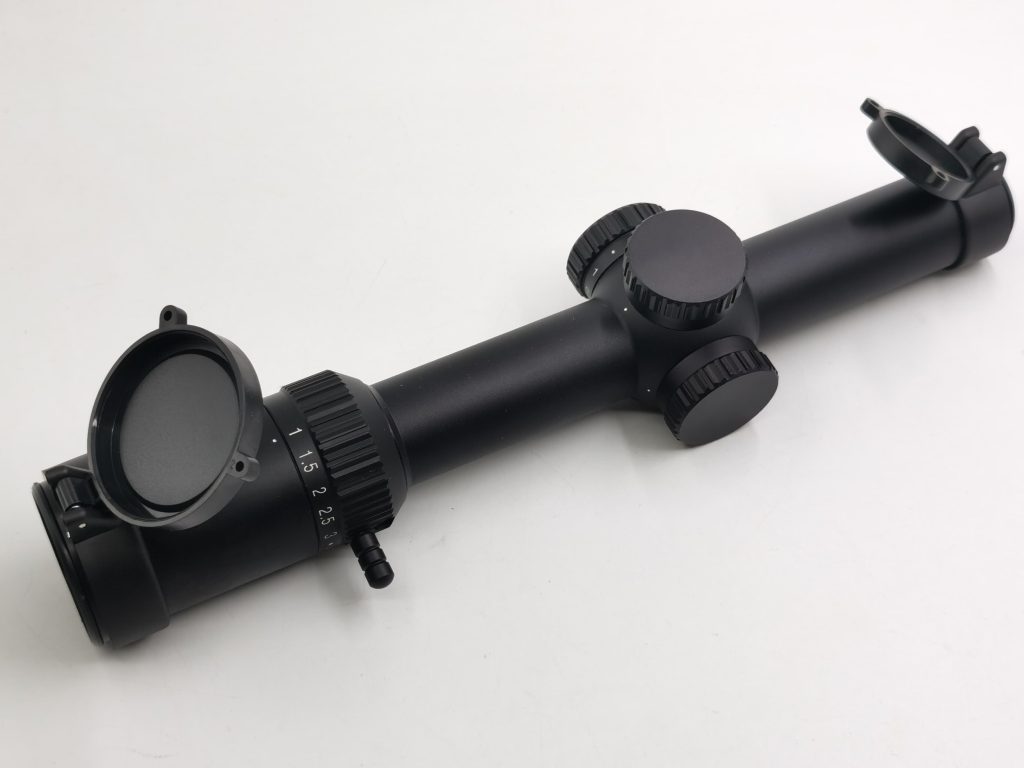
Our own experience adds useful context. The phenomenon of a nominal 1× that does not quite look like unaided vision did not begin with high-zoom-ratio products; it was already present in the 1–6× era. We launched a 1–6×24 in 2018, co-developed with an established European customer, and have manufactured and shipped it consistently for years. Our 1–8×24 followed in 2023, while 1–10×24 and 1–10×28 models began rolling out in 2025. One customer rarely mentioned this issue with the 1–6×24 but began reporting that the image “seemed smaller” after moving to the 1–8×. The assessment criteria and the observer’s eyes were unchanged; the zoom ratio was the variable. This perception is not imaginary and does not, by itself, warrant suspicion of the manufacturer. Rather, it marks the point at which a larger zoom ratio makes optical trade-offs more visible.
2. Why can a true 1× still appear to minify the view?
The issue usually arises because local magnification is not perfectly uniform across the field of view.
Suppose an LPVO has an angular magnification of exactly 1.00× at the optical center, but the local magnification changes progressively toward the edge:
Center 1.00× → mid-field 0.98× → edge 0.94×
The size of a central target is then correct, but the surrounding scene is increasingly “compressed” toward the center.
The user’s overall impression may be that:
The entire view through the scope has shrunk a little.
This is closely related to geometric distortion.
3. Beyond barrel distortion: LPVOs can also exhibit pincushion or mixed distortion
To give a responsible answer, we need to correct a common misconception:
An unnatural-looking view at an LPVO’s lowest setting is not always caused by barrel distortion.
Common forms of geometric distortion in optical systems include:
| Type | Optical behavior | Possible visible effect |
| Barrel distortion | Local magnification decreases toward the edge; image points are compressed toward the center | Edges appear “pushed inward,” potentially creating a minified or fisheye impression |
| Pincushion distortion | Local magnification increases toward the edge; image points spread outward | Edges are stretched and straight lines bow inward |
| Mixed distortion | The sign of distortion changes across the field | Spatial changes in the mid-field and at the edge run in different directions |
Following international standards, FORESEEN Optics likewise defines barrel distortion as negative distortion, with decreasing peripheral magnification, and pincushion distortion as positive distortion, with increasing peripheral magnification. More importantly, the distortion curve in a compound optical system need not be monotonic; it can even switch from positive to negative, or vice versa, across the field.
A customer observing obvious pincushion distortion in an LPVO is therefore seeing something entirely consistent with optical principles.
Complex wide-field systems can even exhibit a mixed form commonly called “mustache distortion.”
So, when assessing an LPVO at 1×, it is not enough to ask:
“Is there barrel distortion?”
A more technically useful question is:
“How are angular magnification and the distortion curve distributed across the full field of view?”
4. Why is a natural-looking 1× generally harder to achieve in a 1–10× than in a 1–6×?
We introduced our 1–6×24 in 2018, but did not begin launching the 1–8×24 until 2023, followed by our 1–10×24 and 1–10×28 models in 2025. The optical parameters of a higher zoom ratio interact in complex ways. At the same time, cost control matters to FORESEEN Optics. We do not build hunting optics around exceptionally expensive optical materials or extremely sophisticated, high-step-count aspheric elements, because that would conflict with our goal of supplying cost-effective hunting optics to small and midsize hunting brands worldwide. For brands with limited optical experience, larger global brands may have helped introduce these concepts; nevertheless, these are the technical expectations that need to be established early in a high-zoom-ratio LPVO project.
A 1–6× LPVO, a 1–8× LPVO, and a 1–10× LPVO may all carry “1×” as their lowest setting, but they do not present the same optical design challenge.
The zoom groups inside an LPVO move as magnification changes. The same optical system must provide a wide field of view and rapid target acquisition at 1×, while retaining adequate resolution, chromatic-aberration control, and edge image quality at 8× or 10×.
In practice, the designer must work within many simultaneous constraints:
Resolution, spherical aberration, chromatic aberration, coma, astigmatism, field curvature, distortion, field of view, exit-pupil position, eye relief, eyebox, mechanical length, and the travel range of the zoom groups must all be balanced.
Optical designers in FORESEEN Optics’ network also note the trade-off between reducing distortion and maintaining high resolution. Achieving both lower distortion and higher resolution generally requires more lens elements, more sophisticated glass, or greater overall system complexity.
Moving from 1–6× to 1–8× or 1–10× is therefore not simply a matter of “adding more magnification.”
It asks essentially the same lens assembly to cover more extreme optical states within nearly the same tube diameter, length, and eye-relief constraints.
That is why the 1× end of a high-zoom-ratio LPVO often demands more design skill than that of an ordinary 1–4× or 1–6×.
It is worth being clear about the limits of our own approach. We serve small and midsize hunting brands around the world, so cost must remain negotiable. We therefore choose not to stack expensive materials and aspheric elements in pursuit of extreme specifications, instead reserving that budget for areas that deliver more value. The trade-off is that some extreme metrics will not set industry records; the benefit is a product line that a brand can source and improve consistently over time.
5. For hunting, a mathematically exact 1× has never been essential
This point deserves its own section.
We have explained where the impression of minification comes from, but a more fundamental question remains:
If the 1× end does not perfectly resemble naked-eye vision, does it affect hunting?
Our answer is: not in the vast majority of hunting situations.
That is not because “we cannot achieve it, so we call it unimportant.” It follows from how hunters actually use a scope.
First, hunting is not a side-by-side visual comparison with one’s eye pressed against the scope. A hunter mounts the rifle, finds the target quickly at the lowest setting, confirms it, and takes the shot. This often takes only seconds. At that pace, the eye is focused on the target near the center of the view, while distortion and magnification differences are most apparent toward the periphery. As Vortex puts it, when the shooter concentrates on the reticle and central field, peripheral details are much less obvious and may go unnoticed altogether.
Second, what matters most at low power is the width and flatness of the field of view, not the second decimal place of magnification. In woodland, driven-hunt, and mountain settings, game can appear anywhere and only briefly. Hunters need a field that is wide enough, flat enough, and comfortable to scan. A wide field helps bring the target into view; a flatter one reduces the “swimming” sensation during lateral scanning and eye fatigue during extended observation. If both conditions are met, whether central magnification is 1.00× or 1.05× has little bearing on how quickly the hunter can find and hit a target.
Third, the strongest evidence is what hunters actually use. The ZEISS V8 1.1–8×24 is a prominent premium model for driven hunting, yet its starting magnification is 1.1×. ZEISS describes that 1.1× view as comparable to natural vision and suitable for comfortable both-eyes-open aiming while retaining situational awareness. It also emphasizes a clear, balanced overall image that supports faster target acquisition. Its field of view is 39.6 meters at 100 meters—a specification designed to aid rapid searching.
Note the sequence: ZEISS promotes “1.1×” as a benefit, not a defect. If an exact 1× were indispensable for hunting, no one would pay eight times the price for a scope labeled 1.1×.
Fourth, with both eyes open, the brain needs two images it can combine comfortably. One eye sees the scene directly; the other sees it through the complete LPVO optical system. The brain responds to whether their spatial scale, straight-line geometry, and motion agree. A 1.1× scope with a flat field, clean edges, and a forgiving eyebox may therefore feel more natural than one measuring precisely 1.00× on axis but showing obvious compression at the edge.
That is the visual, rather than mathematical, sense in which ZEISS can compare 1.1× with natural vision.
Fifth, and most practically, design headroom ultimately benefits the user. Allowing the lowest magnification to rise from 1.00× to 1.1× gives the zoom system more design freedom. That freedom can be used to improve wide-field edge quality, distortion distribution, eyebox, eye relief, high-power performance, and mechanical design. For a hunter, these can matter far more than having central magnification precisely equal 1.00×.
That is why we have consistently told customers:
With a sufficiently wide and flat field, central magnification slightly above 1× need not hinder rapid target acquisition or accurate shooting. By contrast, sacrificing field width, edge quality, or eyebox merely to force central magnification to 1.000× may genuinely degrade the hunting experience.
This is why we recommend shifting sample acceptance from “Is the lowest setting exactly 1.00×?” to “Does the entire visual experience feel natural and support fast use?”
6. Why does “not looking like 1×” not automatically mean a false magnification claim?
For OEM customers, the following distinction is crucial.
If magnification is in doubt, first measure:
The actual on-axis angular magnification.
If an instrument shows that the lowest setting is close to the designed 1.00×, yet the view still appears smaller, the next checks should cover:
Distortion, angular magnification distortion, diopter setting, and exit-pupil/eyebox behavior.
Do not jump straight to the conclusion that “the actual magnification is only 0.9×.”
In particular, when an LPVO is used with both eyes open, the brain receives two images at once:
The unaided view through one eye + the image through the complete optical system in the other.
Even if their central sizes match exactly, differences in peripheral scale, straight-line geometry, or image motion as the eye moves will make the brain register that the two views do not quite align.
A truly good 1× experience therefore aims for more than:
1.000×
It also requires:
A natural-feeling spatial scale across the field, distortion pattern, exit-pupil behavior, and binocular image fusion.
7. Why do some LPVOs start at 1.1× or 1.2×?
This is an excellent illustration of LPVO design trade-offs.
Some premium products explicitly begin at 1.1× rather than 1.0×.
For example, the ZEISS V8 is offered in a 1.1–8×24 configuration. ZEISS says this design provides visual balance close to a natural view and suits both-eyes-open observation.
Leupold has also offered the Mark 8 CQBSS 1.1–8×24.
The lesson is that:
A starting magnification numerically closer to 1.000× does not necessarily deliver a better practical viewing experience.
Allowing the minimum to rise from 1.00× to 1.1×, or even 1.2×, gives the entire zoom system more design headroom.
That can help the designer improve:
Wide-field edge quality, distortion distribution, eyebox, eye relief, high-power performance, and mechanical design.
The following outcome is therefore entirely possible:
Product A: labeled 1.0×, with on-axis magnification very close to 1× but obvious compression at the edges;
Product B: actually 1.1×, with a slightly enlarged central target but a more natural overall spatial scale, edge presentation, and binocular fusion.
In rapid real-world viewing, some users may find Product B more like unaided vision.
One qualification is essential:
1.1× remains 1.1× and cannot be called “true 1×” in a technical specification.
The accurate description is:
Some 1.1× or 1.2× designs trade a slightly higher on-axis magnification for a more natural overall visual experience and greater optical design freedom.
8. How should B2B customers set expectations when customizing a 1–8× or 1–10×?
For these projects, we advise against making “the lowest magnification must be 1.00×” the sole acceptance criterion.
A better approach is to evaluate several factors together at the sample stage:
Actual on-axis angular magnification; the distortion curve across the field; changes in local magnification from center to edge; the both-eyes-open view after diopter adjustment; the low-power eyebox; and any obvious image “swim” or spatial stretching when the eye moves laterally.
When comparing products, it is especially important to compare optical architectures of a similar class.
Expecting a cost-constrained 1–10× to have precisely the same 1× appearance as a mature 1–6× is not necessarily a fair engineering comparison.
Here is a practical way to set expectations without relying on laboratory instruments:
① Binocular-fusion test: Choose two targets a few meters apart and switch your gaze rapidly between them at the lowest setting. If the brain seems to struggle to combine the two views, the field may be difficult to fuse. This is less about on-axis magnification than field flatness and eyebox.
② Straight-edge check: Aim at a doorframe, window frame, or sign edge, then move your head slightly from side to side. Look for bent lines or a “swimming” sensation at the edge. This is a straightforward field check of distortion and perceived field flatness.
③ Lateral-movement tracking: Move sideways while keeping a target in view. If the picture becomes blurred or unstable, or makes you slow down involuntarily, the eyebox and distortion are affecting practical use—a test close to how a hunter actually moves.
④ Repeated-mount test: Repeat the sequence “lower rifle—mount rifle—find target” and record the time. How quickly the target can be found is the key practical metric for hunting.
These four tests have one thing in common: they measure how quickly the scope works in use, not how precisely its center measures 1×. We recommend comparing samples this way early in evaluation, because distributor orders and repeat purchases ultimately depend more on a hunter’s few seconds in the woods than on a decimal in a specification sheet.
Conclusion: A genuinely good 1× is a balance, not just a number
For a high-zoom-ratio LPVO:
A nominal 1× ≠ exactly 1× at every point in the field;
A sense of minification ≠ proof of a false magnification claim;
Pincushion distortion ≠ an optical design error;
A 1.1× or 1.2× starting point ≠ an inferior product.
What really needs to be assessed is:
How the designer allocates limited optical design freedom within a given cost, zoom ratio, field of view, eye relief, eyebox, and high-power imaging requirement.
For a 1–8×, and especially a 1–10×, achieving a genuinely natural-feeling 1× is far more complex than simply making the minimum magnification read 1.00.
That is why, when customizing high-zoom-ratio LPVOs, FORESEEN OPTICS encourages customers to assess both measured magnification and the actual visual experience at the sample stage, rather than deciding the claim is false merely because the view appears a little smaller.
For hunting applications, we put it plainly: a sufficiently wide and flat field and a forgiving eyebox can make a central magnification slightly above 1× entirely compatible with fast target acquisition and accurate shooting. Those qualities matter much more than forcing the center to 1.000×.
Understanding this trade-off in advance helps brand customers decide, early in a project:
Whether to prioritize a strict 1.0× starting magnification or accept design latitude around 1.1× in exchange for a better field of view, eyebox, edge presentation, and optical balance throughout the zoom range.
To put these criteria into practice at the sample stage, we can use our production 1–6×24 platform—co-developed with an established European customer in 2018 and shipped consistently since—as a baseline, then compare it with a high-zoom-ratio platform such as a 1–10×28. Applying the same acceptance method to both low-power settings is more informative than demanding that two different classes of optical system look identical. It tells the story better than any specification sheet.