If we look at the outdoor optics market over the past few years, one trend has become increasingly clear: birdwatching is no longer just a niche interest. It is gradually becoming an important force driving product upgrades.
In the past, when users chose binoculars, they often focused first on magnification, objective lens size, and price. But today, more experienced users are judging products from a broader set of perspectives: Is the field of view wide enough? Is the focusing smooth and easy to control? Are the colors natural and accurate? Is the edge image comfortable to look at? Will the binoculars feel tiring after long periods of observation?
At first glance, these may seem like more detailed user feedback. But from a product development perspective, they are actually redefining what makes a “good pair of binoculars.” Birdwatching is not simply about seeing farther. It is a dynamic observation activity that places higher demands on viewing efficiency, identification ability, and long-term comfort. That is why birdwatchers are often among the first users to notice real differences between optical products.
For the outdoor optics industry, this shift is quite meaningful. It shows that product upgrades are moving away from a purely specification-driven and general-purpose approach, and toward a logic that places more value on real usage scenarios and overall system balance.
In other words, birdwatching is pushing outdoor optics to move from “usable” to “better suited for real use,” and from specification competition to experience-driven competition.
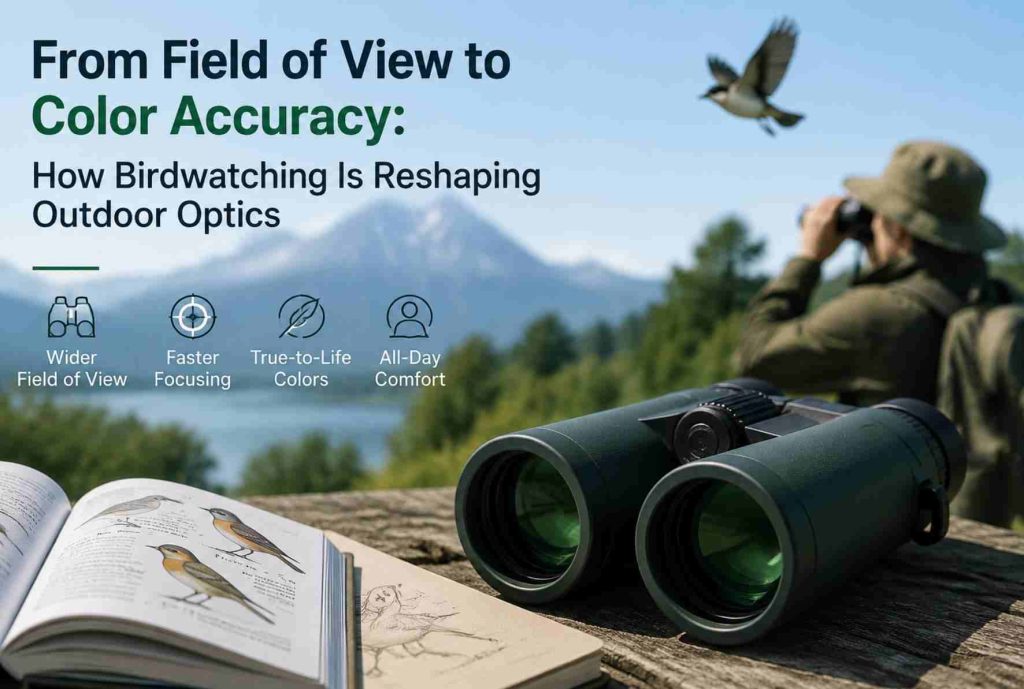
Why Birdwatching Is a Powerful Driver of Optical Innovation
Because birdwatching is not a single observation task. It combines several challenges at the same time.
Unlike many static observation scenarios, birdwatching usually involves subjects that are small, constantly moving, and visible only for a short moment. Birds are often partly hidden by leaves and branches, seen against backlight, reflected water, or complicated natural backgrounds.
In this situation, users do not simply need to “see clearly.” They need to quickly find the subject, lock onto it, follow it smoothly, and then identify details such as feather color, posture, and behavior during continuous observation.
This means birdwatching puts multiple aspects of the user experience under pressure at the same time. Field of view affects how efficiently users can search. Focusing performance determines how smoothly they can track a moving subject. Color accuracy directly influences identification. Overall balance, eye relief, and viewing comfort decide whether the binoculars remain comfortable during long periods of use.
Because birdwatching does not test just one isolated specification, it often reveals the true performance level of an optical product more clearly than many other scenarios. That is also why it is so effective at pushing an entire product line toward meaningful upgrades.
Birdwatchers are also important because they tend to develop a more mature sense of product experience.
Many general consumers may compare binoculars mainly by asking, “How much magnification does it have?” or “Is the price reasonable?” Birdwatchers, however, usually have a clearer understanding of what they need in real use. They are also better at describing their expectations in practical terms.
For example, they may care about whether the wide field of view makes searching more efficient, whether the color reproduction looks natural, whether the edge image feels comfortable, whether the binoculars are friendly for eyeglass wearers, and whether the overall body design is suitable for long periods of handheld observation.
For brands and manufacturers, this is a key point. Birdwatchers are not simply asking for “higher specifications.” Instead, they are helping shape a more mature evaluation system for optical products.
Once this kind of evaluation standard is accepted by a wider market, the direction of the entire industry will also begin to change.
From Field of View to Color Accuracy: What Upgrades Is Birdwatching Really Driving?
If we break down birdwatching needs, we can see that they are not pushing just one isolated improvement. Instead, they are driving a more systematic upgrade across multiple dimensions.
The first upgrade is the growing emphasis on a wider field of view and higher search efficiency. Birdwatching is not a scenario where users can slowly scan and search for the target. Birds often appear quickly and disappear just as fast. The wider the field of view, the easier it is for users to observe more efficiently.
The second upgrade is the rising demand for focusing response and handling feel. On a specification sheet, many products may look quite similar. But once they are actually used in the field, birdwatchers can quickly feel the difference. Is the focusing smooth? Can it keep up with a moving subject? Is the grip comfortable? These details directly affect how users evaluate the product.
The third upgrade is the increasing importance of color reproduction and viewing comfort. Birdwatching is not just about “seeing a bird.” In many cases, users need to identify subtle feather tones, outline details, and changes in movement. If the color is noticeably inaccurate, or if the image feels tiring after long periods of observation, the product’s value will be weakened.
That is why birdwatching pushes manufacturers to make more refined improvements, from lenses and coatings to the overall balance of the optical system.
Six Core Dimensions of Product Upgrade in Birdwatching Optics
Field of View: Efficiency Over Specification
In birdwatching, a wider field of view means it is easier to find a subject in a complex background. It also makes it easier to keep tracking the bird when it moves.
Many users eventually realize that a wide field of view is not just about making the image feel more comfortable. More importantly, it directly improves real observation efficiency.
This is why more product lines are starting to place renewed emphasis on field-of-view performance. It is no longer just a secondary specification. It has become a core capability that directly shapes the user’s experience.
Focusing and Handling: From “Adjustable” to “Smooth and Fast Enough to Follow”
One of the experience differences birdwatchers are most sensitive to is whether the focusing feels natural and easy to control.
The damping of the focus wheel, focusing response, fine adjustment accuracy, and overall handling logic all affect whether the user can quickly bring the subject into sharp focus.
This kind of upgrade may not look as obvious as magnification on a spec sheet, but it is extremely important in real use. Once the handling is better aligned with the actual birdwatching scenario, user satisfaction improves noticeably.
Color Reproduction: Accuracy Over Aesthetics
It Is Not About Looking Better, but Identifying More Accurately
For birdwatching, color reproduction is not just a nice extra. It is part of the product’s practical performance.
Identifying feather colors, recognizing fine details, and judging depth and layers in the environment all require more natural and accurate color performance.
So, improving color reproduction is essentially about improving observation quality. It is not simply a change in visual style.
Long-Term Comfort: Birdwatching Makes Fatigue Much More Noticeable
Birdwatching is usually not a short-use scenario. Many users spend long periods observing in the field. During this kind of frequent and extended use, factors such as overall weight, balance, eyecup design, eye relief, and edge viewing comfort become much more noticeable.
In other words, a product truly suited for birdwatching should not only allow users to see clearly. It should also allow them to keep watching comfortably for a long time.
This is pushing outdoor optics products to improve comfort in a more systematic way.
System Balance: The Importance of Holistic Design
Birdwatching Drives Whole-Product Upgrades, Not Just Single-Spec Improvements
At first, many people may think that improving one major specification is enough to make a product more suitable for birdwatching. But in real use, birdwatching places especially high demands on overall system balance.
Field of view, focusing, color performance, weight, handling, and comfort all work together. If any one of these areas has an obvious weakness, the final user experience will be affected.
So, the upgrades driven by birdwatching are not about simply adding more features or pushing one specification higher. They are about coordinated optimization across the entire product.
This is also why feedback from birdwatchers is often highly valuable when defining future product lines.
Scenario-Based Product Definition
The Market Is Moving from “General Outdoor Use” to Clear Scenario-Based Positioning
As birdwatching needs become more clearly defined, many brands and manufacturers are starting to realize that the old approach of using one product series to cover all outdoor users is no longer precise enough.
In the future, more competitive products will not be the ones that claim to be “a little bit suitable for everything.” Instead, they will be products built around clear scenarios such as birdwatching, with a more accurate product route and a more convincing user experience.
From the Manufacturing Side: Why Is Birdwatching Forcing a Change in Development Logic?
From a manufacturing perspective, birdwatching is important not only because it brings in a more active group of end users, but also because it pushes product development back to the real task itself.
In the past, many product development decisions were driven by questions such as: Are the specifications easy to explain? Is the price range complete? Does the product series look well organized? But birdwatching demand forces teams to think about a different set of questions: In what environments do users most often observe? What pain points matter most to them? What kind of experience is most likely to turn into positive word of mouth?
Once this way of thinking is established, the logic behind product upgrades begins to change. Development is no longer just about improving one isolated specification. Instead, it becomes a process of designing the whole system around real user experience.
That is why birdwatching is becoming an important starting point for the outdoor optics industry to move from simply “making products” to building clearer and more scenario-driven product routes.

Future Trends in Outdoor Optics Driven by Birdwatching
First, product development around birdwatching scenarios will become more clearly defined. The market will place more value on products that achieve overall balance in field of view, focusing, comfort, and color performance, rather than products that simply stand out in one single specification.
Second, the way products are communicated to end users will continue to change. Users are more likely to be convinced by real scenario-based value, such as “finding the subject faster,” “watching longer with less fatigue,” and “identifying feather colors more naturally,” rather than by paper specifications alone.
Third, birdwatching demand will continue to influence a wider range of outdoor optics categories. Once the industry begins to value the system-upgrade logic brought by real usage scenarios, this approach will not remain limited to binoculars. It will gradually extend into more product lines across the outdoor optics market.
Conclusion
From field of view to color accuracy, birdwatching is driving the upgrade of outdoor optics not because it is simply a popular label, but because it reflects users’ real expectations for the observation experience.
For brands and manufacturers, this is exactly where the value of birdwatching demand lies. It reminds the entire industry that a truly competitive product is not defined by one stronger-looking specification. What matters more is whether the product can accurately match a specific scenario, solve real user pain points, and improve the long-term viewing experience.
Those who understand this earlier will be more likely to take the lead in the next round of product upgrades.