In hunting scenarios, competition in outdoor optics is no longer simply about “who has the higher specifications.” Whether we are talking about binoculars, rifle scopes, spotting scopes, rangefinders, night vision devices, or thermal imaging equipment, what truly influences a buyer’s decision is often whether the product has achieved the right balance between performance and structure.
From a manufacturing perspective, “performance” usually refers to image quality, low-light capability, ranging accuracy, reticle usability, target recognition efficiency, and adaptability to different environments. “Structure,” on the other hand, is not only about external design. It also includes weight and size, mechanical strength, sealing and protection, operating logic, mounting compatibility, power supply design, and long-term production stability.
Many products look very impressive during the sampling stage. They may offer a wider field of view, higher magnification, a shorter body, more functions, and a more competitive price. However, once they enter real hunting conditions, new problems can quickly appear. The product may be too heavy for long hours of carrying, the structure may be too aggressive and bring reliability risks, the adjustment layout may not feel intuitive, the overall balance of the body may be poor, the sealing may become unstable in rain or fog, or too many added functions may fail to genuinely improve the user’s efficiency.
For this reason, this article will follow a manufacturing-side logic and answer several practical questions:
- In hunting scenarios, why can outdoor optics not be judged only by performance, or only by structure?
- For different types of optical products, where should the balance between performance and structure be focused?
- When planning a product line, how should brand owners make trade-offs based on real application scenarios?
- In OEM / ODM projects, where do problems most often occur when a product has “good-looking specifications” but does not sell well in the market?
- Across different price ranges, what kind of balancing strategy is more suitable for long-term sales?
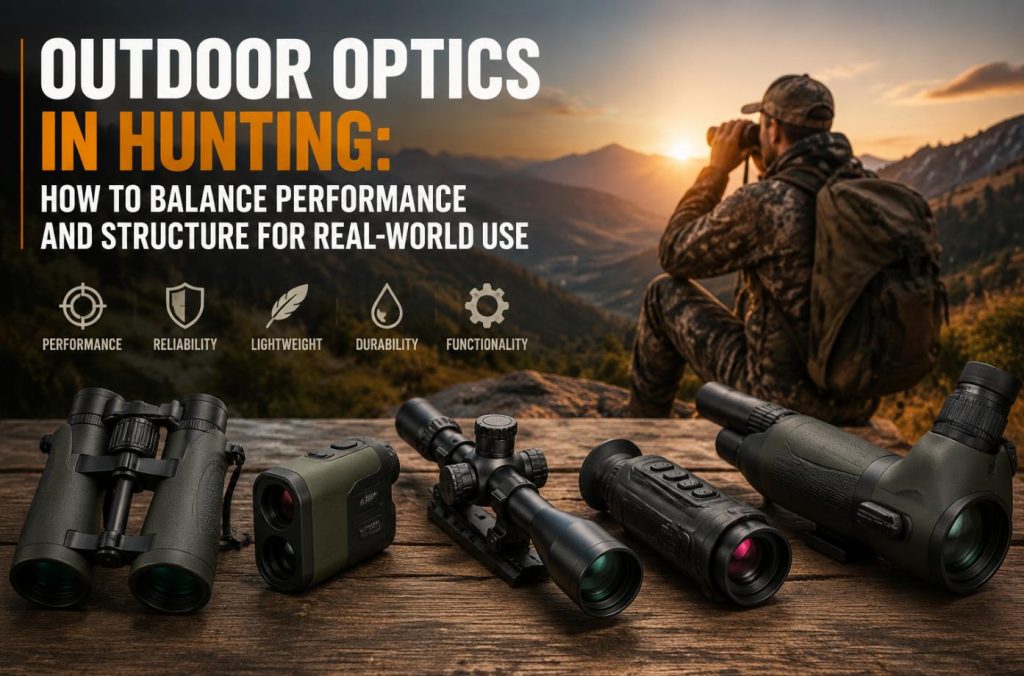
What Does “Balancing Performance and Structure” Really Mean?
From a manufacturing perspective, balancing performance and structure does not simply mean finding a middle point between “clearer image” and “lighter body.” Instead, it means deciding which capabilities must be prioritized and which areas can be reasonably compromised based on the target application scenario.
For example, in binoculars, performance may be reflected in low-light performance, color reproduction, edge clarity, and field of view. Structure, however, is more closely related to grip comfort, weight, hinge resistance, waterproof and fog-proof protection, and the overall carrying experience during long hours in the field.
For thermal imaging or rangefinding products, performance may focus more on detection distance, identification capability, refresh performance, and algorithm stability. Structure, on the other hand, is often more about button layout, battery design, assembly reliability, and compatibility with firearms or accessory systems.
Therefore, balance does not mean making every specification the best possible. It means that, under the intended hunting scenario, the key capabilities have no obvious weaknesses, and the overall user experience feels well-coordinated.
Why Does Hunting Make This Balance More Important?
Hunting is not a laboratory environment. It requires equipment to keep working in real-world conditions that are complex and constantly changing. This is why a single performance specification can rarely represent the true value of a product in actual use.
Hunting Conditions Are Dynamic
The same user may use the same piece of equipment at dawn, at dusk, in woodland, on open grassland, in mountainous areas, or in wet environments. The more the environment changes, the less a product can rely on just one strong selling point.
Hunting Is Highly Sensitive to Weight
Hunters do not carry only one optical device in the field. They may also carry a rifle, ammunition, drinking water, a first-aid kit, lighting tools, warm clothing, and other outdoor essentials. Every extra gram of weight and every additional accessory can increase the overall burden on the user.
Hunting Requires Fast and Efficient Operation
Many hunting opportunities last only for a short moment. Whether the user is raising binoculars to quickly scan an area, switching to a rangefinder, reading a reticle, or confirming a target, the product must feel intuitive, smooth, and easy to operate.
Hunting Has a Low Tolerance for Reliability Issues
A product may look excellent during an indoor demonstration, but if it starts to show problems after exposure to low temperatures, moisture, dust, recoil, or continuous use, then even the strongest performance specifications lose their meaning.
How Outdoor Optics Competition Has Evolved
In the past, competition in the outdoor optics industry was largely specification-driven. Magnification, objective lens diameter, field of view, ranging distance, refresh rate, and display resolution were all easy selling points to communicate. However, as the market becomes more mature, truly competitive brands are shifting from “maximizing individual specifications” to “building the right product line structure.”
Early Stage: Specification-Driven Competition
At this stage, product definition was often built around ideas such as a larger objective lens, longer ranging distance, or higher magnification. Sales teams also tended to focus on measurable specifications because they were easy for customers to understand and compare.
Middle Stage: Stronger Scenario Awareness
Brands then began to realize that products should not simply be ranked from low to high based on specifications. Different products serve different users and different use cases. As a result, more clearly defined product categories started to appear, such as hunting binoculars, competition rifle scopes, lightweight hiking models, long-range spotting scopes, and compact rangefinders.
Current Stage: From Individual Products to Product Line Synergy
Today, a mature product line is no longer about pushing maximum performance on a single product. Instead, it is about creating clear roles across different categories: which product is responsible for scanning, which one supports aiming, which one helps with long-distance judgment, and which one adds night-time capability.
At this stage, the real competition is no longer about “which single product is the strongest,” but about “whether the entire product line truly understands the scenario.”
Five Questions Brand Owners Should Answer Before Defining a Product Line
Before defining an outdoor optics product line for hunting, brand owners should first answer five key questions:
Q1: Who is your target user?
Are you serving traditional hunters, hunting guides, professional shooters, or mixed-use users who combine outdoor observation with light hunting applications?
Q2: What is your primary hunting environment?
Is the product mainly for woodland, mountainous terrain, open fields, low-light conditions, or mixed day-and-night use?
Q3: What is the main purpose of your product line?
Are you trying to build a high-volume core model, or a premium model that strengthens your brand image?
Q4: What is your core selling point?
Is your product line more focused on lightweight comfort, or on maximum performance and broader scenario coverage?
Q5: Can your target cost and retail price support the materials, structure, and validation level you want?
A strong product concept must also be realistic enough to support stable manufacturing, quality control, and long-term sales.
If these five questions are not clarified at the beginning, it is easy to fall into the trap of wanting everything at once: a brighter image, lighter weight, shorter body, stronger structure, lower price, and more functions. The result is often a prototype that looks exciting on paper, but becomes difficult to mass-produce and unclear in market positioning.
How to Evaluate an Outdoor Optics Product Line: Start with Five Dimensions
When evaluating an outdoor optics product line, it is important to look beyond individual specifications. A more practical approach is to assess the product from five key dimensions.
Optical and Detection Performance
This is the part users can feel most directly. It includes image clarity, contrast, color reproduction, low-light detail, ranging stability, and the detection and identification performance of thermal imaging devices.
Structural Reliability
This includes waterproof and fog-proof protection, impact resistance, focusing durability, button lifespan, body strength, sealing performance, and long-term consistency in use. Many after-sales issues often appear in this dimension.
Weight, Size, and Ergonomics
In hunting scenarios, weight is not simply a matter of “the lighter, the better.” The key is whether the product achieves the right balance between comfort and stability. A product that is too light may compromise grip feel or structural strength, while a product that is too heavy can directly affect the carrying experience.
Operation and System Compatibility
This includes the adjustment logic of a rifle scope, the information reading efficiency of a rangefinder, the menu interaction of a thermal device, the convenience of battery replacement, and compatibility with mounts, firearm platforms, and accessory systems.
Supply Chain and Mass Production Stability
Procurement is not about buying one sample. It is about choosing a platform that can be delivered consistently over time. Component sourcing, assembly cleanliness, inspection processes, and consistency in future replenishment all affect a brand’s long-term market performance.
Different Product Types Have Different Balance Priorities
When we break down an “outdoor optics product line” into different product categories, the balance between performance and structure is not the same for every product.
| Product Type | Key Performance Focus | Key Structural Focus | Typical Balance Logic |
| Hunting Binoculars | Low-light performance, field of view, viewing comfort | Weight, grip, waterproof and fog-proof protection | Easy to view for long periods, stable in hand, and light enough to carry |
| Rifle Scopes / LPVOs | Reticle usability, brightness, adjustment precision | Body strength, mounting compatibility, operation logic | A balance between fast aiming and reliable performance |
| Spotting Scopes | Long-distance resolution, detail recognition | Tripod compatibility, size, mechanical stability | Higher magnification does not always mean better all-scenario usability |
| Laser Rangefinders | Ranging stability, return signal efficiency, reading speed | Button layout, one-hand operation, portability | Operation efficiency matters more than stacking extra functions |
| Night Vision / Thermal Imaging Devices | Detection and identification, refresh performance, image algorithms | Battery design, weight, mounting interface, weather resistance | Fast target judgment and deployment within a short time window |
Manufacturing Capabilities That Define Product Success
From the manufacturing side, achieving a good balance between performance and structure is not only about selecting better components. It depends on several core capabilities behind the product development process.
- Scenario Definition Capability
Whether a factory can develop a good product often depends on whether it truly understands the end-use scenario. A team that does not understand hunting applications may easily create a product with “acceptable specifications” but poor real-world usability.
- System Integration Capability
Performance and structure are never two separate modules. For example, if the body is made shorter, will it affect adjustment space and structural strength? If the objective lens is made larger to improve low-light performance, will it also increase weight and size? These trade-offs require strong system integration capability.
- Industrial Design and Ergonomics Capability
Product design is not only about appearance. Grip shape, focusing resistance, button position, eyecup design, and strap attachment points all affect how the product feels in the hands of the end user.
- Validation and Testing Capability
An experienced manufacturer will move key tests forward in the development process, instead of only trying to make the sample “look good.” These tests may include high and low temperature, humidity, drop impact, vibration, waterproof performance, button lifespan, focusing lifespan, and consistency in optical-mechanical alignment.
- Mass Production and Continuous Supply Capability
Even if a product achieves a good balance at the design stage, it still cannot build long-term competitiveness if mass production brings large batch differences, unstable replenishment, or difficult after-sales replacement. A truly balanced product must also be stable and sustainable as a supply platform.
How Hunting Scenarios Change Product Requirements
Different hunting environments place different demands on an outdoor optics product line. A well-planned product line should not use the same balance logic for every scenario.
Woodland and Brush Environments
In woodland and brush environments, search efficiency, wide field of view, low-light capability, and fast target acquisition are more important. For this type of scenario, the product line should give priority to portability and ease of use, instead of blindly pursuing higher magnification.
Mountainous Terrain and Open Fields
Longer-distance observation makes higher magnification, spotting scopes, and stronger ranging capability more valuable. At the same time, the product line must still control carrying weight and ensure that the support system and overall structure remain stable.
Dawn, Dusk, and Low-Light Ambush Hunting
In these conditions, low-light imaging, thermal assistance, and target identification efficiency become much more important. The key is to make practical trade-offs between brightness, detail recognition, and power supply design.
Mobile Stalking and Long-Distance Walking
In this scenario, the most important factor is often not maximum performance. Instead, users care more about low carrying burden, fast response, and reduced overall load. Products that are too heavy or structurally over-complicated may significantly reduce the user’s willingness to carry and use them.

How to Achieve a More Reasonable Balance Across Different Price Ranges
| Price Range | More Suitable Balance Strategy | Procurement Focus |
| Entry-Level | Give priority to mature platforms and avoid stacking too many functions | Cost control, stable delivery, and a basic user experience without obvious weaknesses |
| Mainstream Mid-Range | Strengthen core scenario-based capabilities while maintaining structural comfort | Balance low-light performance, reliability, and market acceptance |
| High-End | Allow higher-grade materials and deeper structural optimization | Focus on differentiation, long-term reputation, and broader scenario coverage |
If the goal is mainstream sales volume, the most reasonable approach is usually not to put every possible function into one product. Instead, the product should focus on one or two key use scenarios and make sure the core experience has no obvious weaknesses.
For a high-end product line, it is worth investing in better materials, coatings, structural details, and deeper validation. However, this only makes sense when the target users truly recognize these values and are willing to pay for them.
What Should Brand Owners Confirm During Procurement and ODM Communication?
When communicating with an ODM supplier, brand owners should not only ask whether a product can be made. More importantly, they should confirm whether the product platform truly fits the intended market and use scenario.
- Why is this product platform suitable for my target scenario, instead of simply having “higher specifications”?
- Can the supplier clearly explain the structural cost behind each performance improvement?
This may include weight, size, cost, and the difficulty of validation. - Do the key structural parts and optical components come from a mature supply chain?
- Is the reliability validation sufficient?
This should include waterproof, fog-proof, drop, vibration, temperature difference, and lifespan testing. - How is consistency between different production batches guaranteed?
Are after-sales replacement and future replenishment convenient? - Can a tiered product line be built on the same platform, instead of developing every model from the beginning?
From a manufacturing perspective, the best communication is not just asking, “Can you make it?” A more effective approach is to clearly tell the factory what type of user the product is for, which scenario it is built around, what price range is acceptable, and which performance points must be prioritized. Only in this way can the balance between performance and structure be truly done right.

Why Product Line Logic Matters More Than Specs
A Truly Competitive Product Line Is Not About the Strongest Single Specification, but the Clearest Overall Logic
In hunting scenarios, the core question for an outdoor optics product line is never simply “which matters more, performance or structure?” The real question is how to combine the two in the most reasonable way for the target scenario.
If a product blindly pursues higher performance, it may create pressure in weight, complexity, cost, and reliability. If it focuses too much on lightweight structure, it may sacrifice image quality, target identification, or operating efficiency in key hunting conditions.
From a manufacturing perspective, a truly competitive product line usually has several clear characteristics: well-defined scenarios, clear category roles, focused selling points, performance and structure that support each other, stable production consistency, and a reliable user experience over long-term use.
For brand owners, the earlier they understand this logic, the better chance they have to take the lead in the next round of product line competition. Future procurement decisions will not be based only on “which specification is higher.” They will increasingly depend on whether the product line truly understands the user, the scenario, and the manufacturing process behind the product.
FAQ
Q1: Does higher performance always make a product easier to sell?
Not necessarily. If higher performance also brings a clear increase in weight, size, cost, or operating complexity, the product may not be suitable for the target market.
Q2: Is lightweight design always the right direction?
No. Excessive weight reduction may affect structural strength, holding stability, or low-light performance. The key is to find the right balance based on the actual use scenario.
Q3: Should a product line cover every possible function?
It is not recommended to blindly cover everything. A more practical approach is to build a tiered product line around core scenarios, so that each product category has a clear role.
Q4: What kind of requirement is most difficult for manufacturers?
The most difficult requirement is a vague request for “everything at once, but without increasing cost.” Without a clear scenario and price range, the project can easily go back and forth many times.
Q5: What is most easily overlooked during procurement?
Mass production consistency and long-term reliability are often overlooked. A good-looking sample does not always mean stable bulk production.
Closing Note
If you are planning an outdoor optics product line for hunting applications, it may be more valuable to stop comparing products only by one single specification and first ask yourself a more important question:
In what environment will my target users actually use these products?
Once this question is clearly answered, the trade-off between performance and structure, the role of each product category, and the overall procurement strategy will all become much clearer.