If you have ever moved from an open outdoor shooting range to an indoor shooting position, or pulled out your home defense handgun in a dimly lit room, you may have noticed a peculiar phenomenon: the red dot that appears crystal clear outdoors might appear overly bright, blurry, or even distracting in an indoor or dimly lit environment.
This is not a defect of the scope itself, but rather the result of the interaction of factors such as human visual perception, environmental light, and brightness settings. In this article, we will delve into the visibility principle of the red dot sight, explain why indoor environments cause “halo effect”, and how to adjust the brightness settings to make the scope work in harmony with your eyes instead of against them.
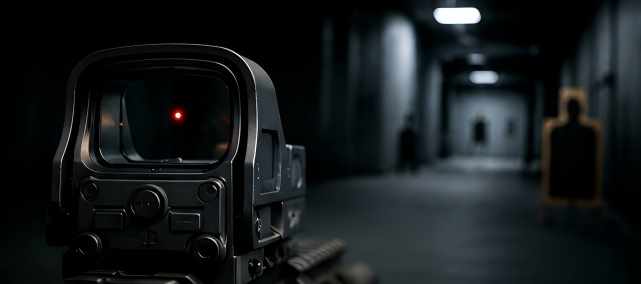
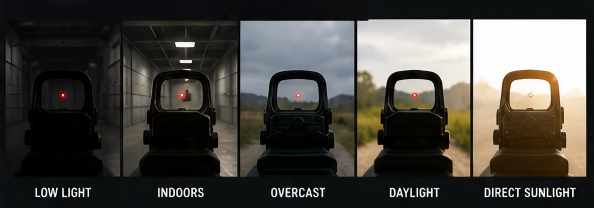
Red Dot Visibility in Different Lighting Conditions Explained
The red dot sight does not project laser beams onto the target like a laser sight; instead, it uses an LED light source to reflect light onto a specially designed curved lens, which then reflects the light into the human eye. Therefore, its visibility largely depends on the contrast between the LED light source and the surrounding environment.
In a bright light environment, the pupil will constrict, and the brain requires a brighter LED light source to make the aiming line stand out against the background. In low light or indoor conditions, the pupil will dilate to absorb more light, and at this time, the sensitivity of the eyes to the LED light source will significantly increase. This change is not merely an issue of optical principles, but rather a matter of how the human eye adapts to different lighting conditions.
Why Red Dots Can Look Too Bright Indoors
If you walk indoors with your optic still set to its outdoor “daylight bright” setting, you will immediately run into performance issues. Here is why indoors changes everything:
Low Ambient Light Makes the Dot Appear Larger
When you are in a dimly lit room, the stark contrast between the dark background and the illuminated LED tricks your brain into perceiving the dot as much larger and more intense than it actually is.
Blooming and Halo Effects in Dark Environments
When an optic is too bright for a dark room, the excess light floods your dilated pupil. This causes “blooming” (a fuzzy, pixelated explosion of light) or a “halo effect” (a ghost ring reflecting around the edges of the window). If you have astigmatism, this effect is severely amplified.
Reflective Surfaces Inside Indoor Shooting Ranges
Many indoor ranges feature acoustic paneling, concrete walls, or metallic target carriers that can catch and reflect light awkwardly, compounding glare and visual distraction.
Why High Brightness Settings Make the Problem Worse
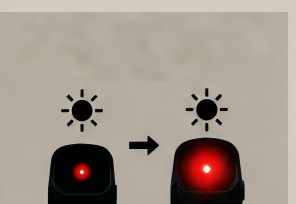
A dot that is too bright ceases to be a precise aiming point. It washes out your target, making it incredibly difficult to identify what you are shooting at or to maintain a crisp focus on the threat.
Why Red Dots Can Look Dim or Washed Out Outdoors
Conversely, the exact opposite problem occurs when you step into the sun.
Sunlight Overpowering the LED Dot
Direct sunlight—especially mid-day overhead sun—pours an immense amount of lumens into your optic’s window. If your LED isn’t powerful enough, the ambient sunlight will completely drown out the reticle.
Incorrect Brightness Setting for Daylight Use
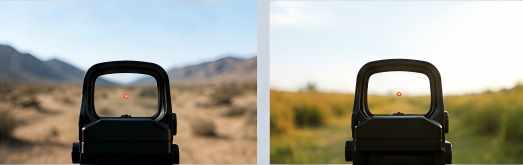
If you forget to manually increase the brightness when moving outdoors, it will result in the aiming point being almost invisible, forcing you to search for a non-existent aiming line.
Background Color and Target Contrast Issues
The brightness setting required to aim at the brownish earth embankment, the bright white steel target, or the faded concrete wall due to sun exposure is much higher than that needed to aim at dark shadow targets.
Lens Tint and Coating Influence on Visibility
High-end optical sights use precise notch filters (coatings on glass) to reflect red light while allowing other light to pass through. In contrast, cheap optical sights usually have a distinct blue or green tint to make the red dot appear brighter, but this can severely reduce the clarity of aiming in strong sunlight.
How to Choose the Right Brightness for Different Environments
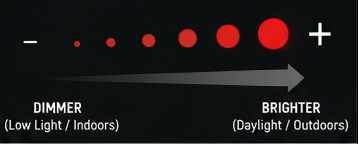
Finding the optimal brightness is about balance: you want the reticle to be translucent, not opaque. You should always be able to see the target through the dot.
| Environment | Recommended Setting Strategy | Pro-Tip |
| Indoor Range / Low Light | Low-to-Medium (Step it down until the fuzzy edges disappear) | The dot should be just bright enough to track easily during recoil without glowing. |
| Direct Outdoor Sunlight | High / Maximum (Daylight Bright) | If the dot looks perfectly crisp but slightly faint, click it up one more notch. |
| Home Defense (Darkness) | Low / Night-Vision adjacent | Program the optic for the environment you expect to defend, not a bright showroom floor. |
The “Auto-Brightness” Dilemma
Many modern optics feature automatic brightness sensors. While convenient for casual range use, they have a fatal flaw known as photonic mismatch. If you are standing in a dark room (causing the optic to select a low setting) but aiming out into a brightly lit hallway or courtyard, the dot will completely vanish against the bright background. For duty or self-defense, setting your brightness manually to match the brightest potential environment is generally preferred by experts.
In Conclusion
A red dot sight is only as good as its configuration. If your dot looks like a blurry mess indoors, it isn’t broken—it’s just choked with too much power for your dilated eyes. By understanding how ambient light affects your vision, dialing back the brightness indoors to eliminate blooming, and manually overriding your settings when changing environments, you can ensure a crisp, precise aiming point every single time you present your firearm.