If you’ve ever set up a red dot on a pistol, you’ve probably run into the same question: should you zero at 10, 15, or 25 yards?
There’s no shortage of opinions online. Some shooters insist on a 25-yard zero because it’s “standard.” Others prefer 10 yards for simplicity. Then there’s the increasingly popular 15-yard option sitting somewhere in between.
The problem is that most discussions stop at preferences, without explaining what those distances actually change—especially in a home defense context. Inside a house, where distances are short and decisions happen fast, the practical impact of your zero matters more than the number itself.

Why Zeroing Distance Feels Confusing in Real Use
Part of the confusion stems from the fact that most people learn how to calibrate red dot scopes. This process is usually carried out at shooting ranges, typically at a distance of 15 or 25 yards, in a controllable and predictable environment.
However, this environment does not reflect the actual usage of pistols in home defense. In an indoor setting, the distance is much shorter, the angles are more precise, and there is almost no time to think and adjust.
Another issue is that many calibration standards were developed for general shooting rather than for close-range defense. As a result, shooters often end up with a set of settings that are theoretically effective but not very intuitive in practical situations.
The key point is not how to calibrate – but rather to understand how the calibrated results will change when the distance shortens.
Common Pistol Red Dot Zeroing Distances Compared
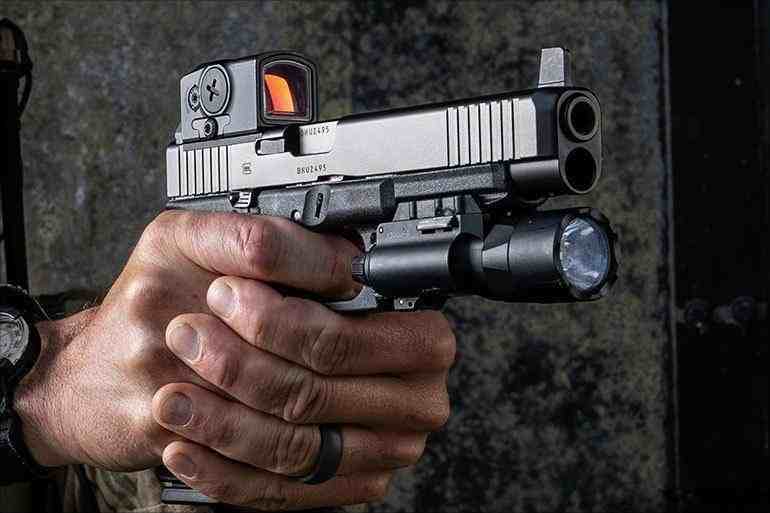
Let’s analyze the three most commonly used ranges for home defense handguns.
10-Yard Zero
A 10-yard zero aligns closely with the distances most people associate with defensive scenarios. At very short range, the point of aim and point of impact feel more intuitive, with less noticeable deviation.
Because of this, many shooters find it easier to use under pressure. There’s less need to think about adjustments, which can simplify decision-making when speed matters most.
The trade-off is that beyond close range, the point of impact may begin to diverge more noticeably from the dot, requiring greater awareness at extended distances.
15-Yard Zero
The 15-yard zero point has become increasingly popular as a compromise solution. It strikes a balance between the practicality of close-range shooting and its broader applicability.
At typical indoor shooting distances, its performance remains predictable, and as the distance increases, its stability also improves. This is a more natural compromise solution for shooters who train both indoors and at the range.
It does not optimize for a single scenario, but rather distributes the performance more evenly across multiple distances.
25-Yard Zero
Zeroing at 25 yards is generally regarded as the traditional standard, especially when used in shooting ranges. It provides a stable aiming point and impact point over a longer distance, and often aligns with structured shooting training.
However, at extremely close range, the difference between the aiming point and the impact point becomes more pronounced. But this does not mean it is ineffective – it merely indicates that the user needs to understand the performance of this system at close range.
For shooters who value versatility or frequently engage in long-distance training, this setup remains applicable.
What Actually Changes Between These Distances
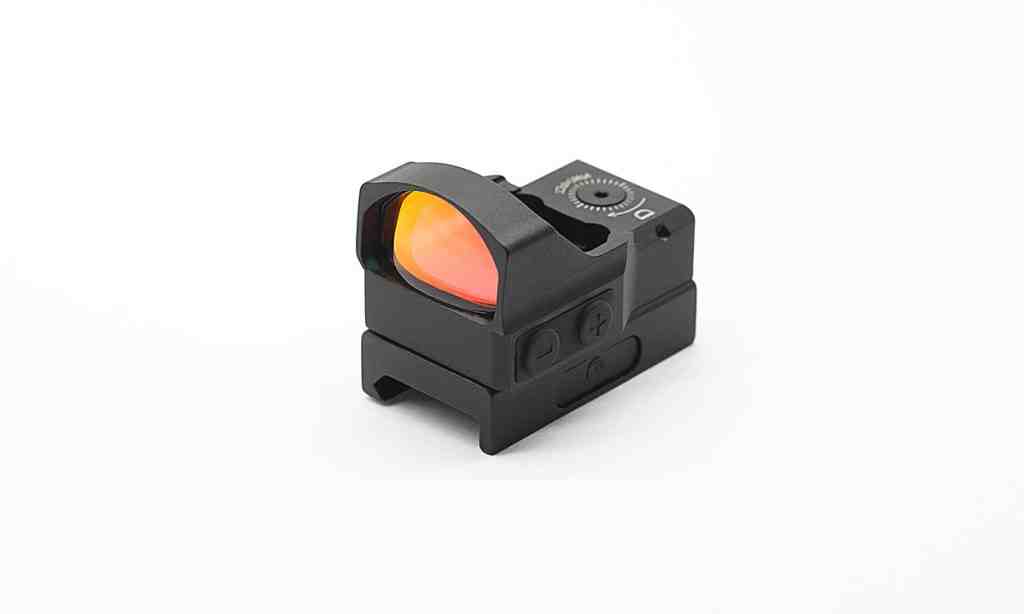
The difference between these zeroing distances isn’t just about numbers—it’s about how the pistol behaves in your hands.
At closer zeros, alignment at short range feels more direct, with less need to compensate. As the zero distance increases, that simplicity shifts toward greater consistency over a wider range of distances.
Another factor is how much mental adjustment is required. Some setups demand more awareness of where the bullet will land relative to the dot, especially at close range. Others reduce that need, but may trade off performance elsewhere.
Ultimately, each zero represents a different balance between simplicity, flexibility, and consistency.
How Zeroing Distance Affects Real-World Use
What Happens at Close Range (3–7 Yards)
When shooting at extremely close range, many shooters will notice an unexpected phenomenon: the bullet’s landing point is often slightly lower than the aiming point. Even if the red dot sight has been correctly zeroed, this can still give the illusion that the red dot is “off target”.
No matter whether the zero distance of the pistol is 10 yards, 15 yards or 25 yards, this phenomenon will occur. At these distances, the differences between different zero points are relatively small, while the deviation that appears during close-range shooting is more obvious.
Understanding Close-Range Offset in Practice
The situation here is caused by the physical relationship between the sight and the barrel. Due to the red dot being slightly higher than the rifling of the barrel, the initial trajectory of the bullet is lower than the aiming line. It will only intersect with the aiming line at the zero distance point.
At extremely close range, the bullet had not yet intersected the aiming line – hence the impact point appeared to be lower.
In fact, this means that even a well-calibrated pistol cannot precisely fire a bullet at the exact location of the red dot at extremely close range. Understanding this phenomenon is more meaningful than merely focusing on the set safe distance.
Speed vs Adjustment Under Stress
In a high-stress situation, the ability to act quickly often outweighs the ability to make precise corrections. A zero that feels intuitive at close range can reduce the need for conscious adjustment, which may help streamline response.
On the other hand, a setup that requires awareness of slight offsets may demand more attention, especially for less experienced users. Neither approach is inherently better—it depends on how the pistol is used and how familiar the shooter is with its behavior.
Consistency Across Distances
Another consideration is how consistently the pistol performs as distance changes. Some zeroing distances provide a more uniform experience across a wider range, while others prioritize simplicity within a narrower window.
Consistency can influence how easily a shooter builds habits. A setup that behaves predictably across multiple distances may feel more natural over time, even if it requires minor adjustments in specific situations.
Practical Considerations for Zeroing a Pistol Red Dot
Match Zero Distance to Actual Use
The most relevant factor in choosing a zero is how the pistol is actually used. A setup intended primarily for close-range defense may benefit from different priorities than one used for regular range training.
Train at Relevant Distances
Zeroing is only part of the equation. Training at the distances that matter most helps bridge the gap between setup and performance, making it easier to understand how the pistol behaves in practice.
Be Aware of Close-Range Impact Behavior
Knowing where rounds will land at very short distances can prevent confusion and improve consistency. This awareness often has a greater impact than the specific zero distance chosen.
Maintain Consistency in Setup
Frequent changes to zeroing distance can make it harder to build reliable habits. Keeping a consistent setup allows for better familiarity and more predictable performance over time.
In Conclusion
There is no single “best” pistol red dot zeroing distance for home defense. Options like 10, 15, and 25 yards each reflect different priorities, from close-range simplicity to broader versatility.
What matters more is understanding how those choices affect real-world behavior—especially at the short distances where defensive use is most likely to occur.
In the end, the effectiveness of a setup depends less on the exact number and more on how well the shooter understands and works with it.