In hiking and lightweight outdoor scenarios, the way buyers evaluate binoculars is clearly changing.
In the past, many buyers tended to focus first on magnification, objective lens size, ED glass, or whether the binoculars offered a wide field of view. But once the product is actually used on hiking trails, mountain routes, long-distance outdoor trips, or quick observation moments, users often care less about whether the specifications look higher on paper. What they notice first is much more practical: whether they are willing to carry the binoculars all day, whether they can raise them quickly for observation, and whether the product feels light, stable, and easy to handle.
For outdoor optics brands and manufacturers, lightweight design is no longer just about reducing a few grams. It is reshaping the entire approach to product planning. Specification selection, structural design, material choices, optical configuration, accessory setup, and price positioning all need to be reconsidered around two key questions: Will users want to carry it? And will they actually use it more often?
This article looks at binocular product definition for hiking scenarios from both the manufacturing and procurement perspectives. It also discusses how outdoor optics brands can build a more practical lightweight product line without simply making the product “smaller” while overlooking the real user experience.
- Why does the hiking scenario change the procurement logic for binoculars?
- Is lightweight design mainly solving a weight problem, or a usage frequency problem?
- How should specifications such as 8×25, 10×25, 8×32, and 10×32 be positioned?
- What trade-offs should manufacturers make in structure, materials, optics, and accessories?
- How can brands build a clearer binocular product line around hiking use?
Why Is the Product Definition Different for Hiking Binoculars?
Hiking is different from traditional hunting, birdwatching, or fixed-position observation. Users are constantly on the move, and they usually need to carry a backpack, water, clothing, food, navigation tools, first-aid supplies, and other outdoor gear at the same time. Because of this, every extra piece of equipment will be reconsidered: Is it really worth the space and weight?
Hiking Users Care More About “Easy to Carry”
In hiking scenarios, if a pair of binoculars is too heavy, too bulky, or inconvenient to pack, users may simply leave it at home or in the car — even if the optical performance is good.
So the first thing lightweight design changes is not the optical specification itself, but the user’s decision to carry the product.
Hiking Observation Requires “Quick Pick-Up and Use”
Observation opportunities during hiking are often brief. It may be a distant ridge, an animal moving through the woods, a trail marker, a valley landscape, or a view that suddenly appears along the route.
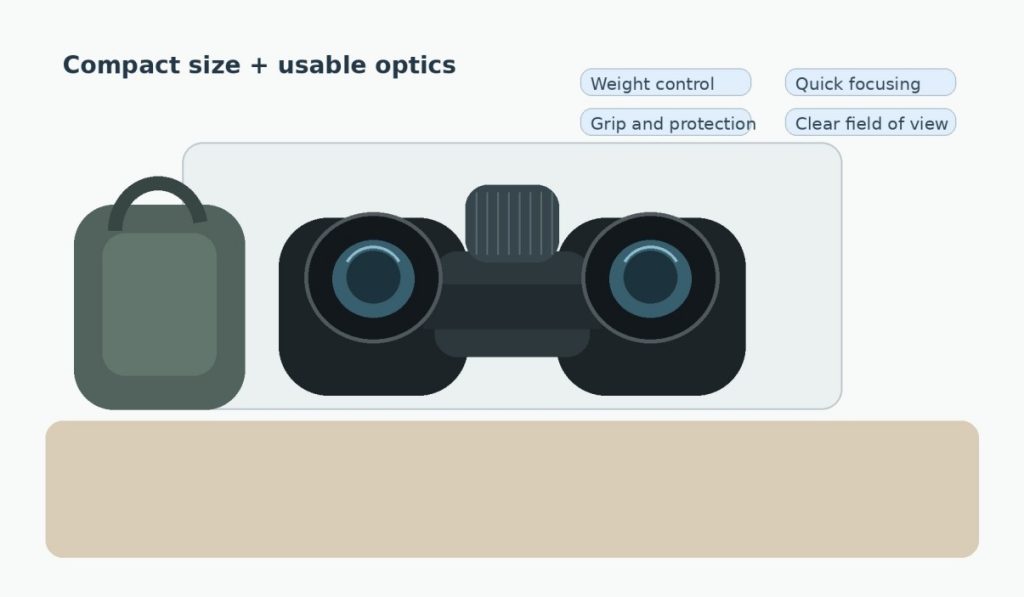
This means the binoculars need to be easy to access, quick to focus, and comfortable to hold. Only then can they truly increase real-world usage frequency.
Hiking Binoculars Need Better Overall Balance
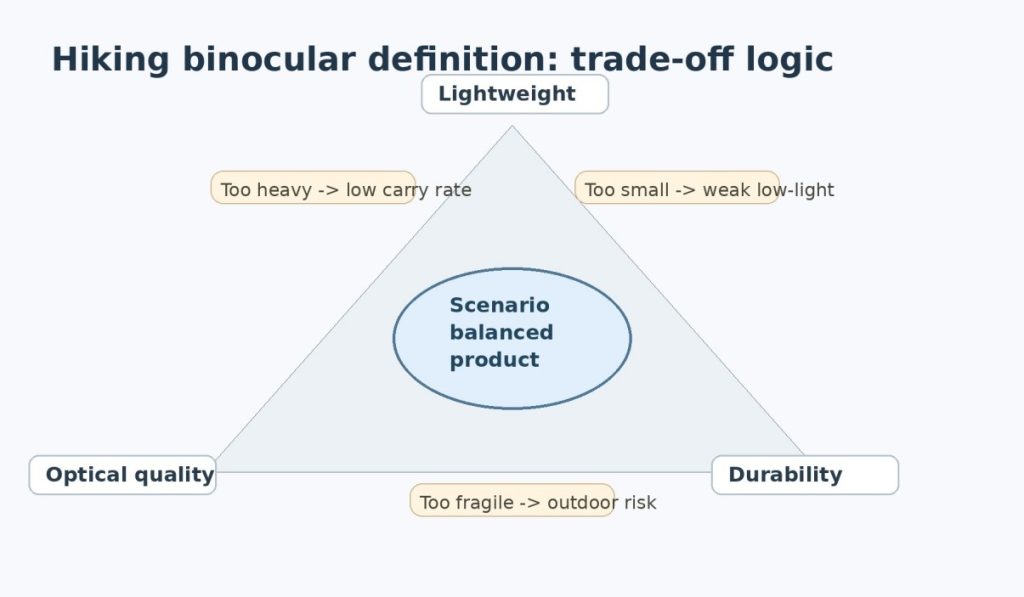
A good pair of hiking binoculars should not simply chase higher magnification, nor should it focus only on extreme weight reduction.
Instead, it needs to find the right balance between weight, field of view, image clarity, low-light performance, durability, and price. The best configuration is not always the one with the highest specifications, but the one that best matches the needs of the target user.
Three Ways Lightweight Design Is Changing Procurement Logic
From “Specifications First” to “Carry Willingness First”
In the past, buyers often started by asking about magnification and objective lens size. But in a hiking binocular product line, the first question is becoming much more practical: Is this product light enough, compact enough, and easy enough to pack?
If users are not willing to take the binoculars outdoors in the first place, even stronger specifications will be hard to turn into real value.
From “Single-Product Performance” to “Scenario-Based Experience”
Hiking binoculars are not used in a static display cabinet. They are used on mountain trails, inside backpacks, with gloves, sweat, rain, fog, accidental bumps, and hours of walking.
So the product experience does not come from the lenses alone. It also comes from the body structure, housing material, strap design, protective case, and the feel of the focus wheel.
From “Bigger Means More Professional” to “Suitable Means Professional”
In hiking scenarios, larger objective lenses and higher magnification do not automatically mean a product is more professional.
Too much magnification can make handheld viewing less stable, while a larger objective lens usually adds more weight and bulk. The truly professional choice is the one that fits the target scenario best.
How Should Specification Routes for Hiking Binoculars Be Understood?
From the manufacturing side, the specification choice for hiking binoculars needs to return to the user profile. Different users have different expectations for weight, clarity, field of view, and price. So specifications should not simply be ranked from low to high. Instead, they should be divided by usage scenarios.
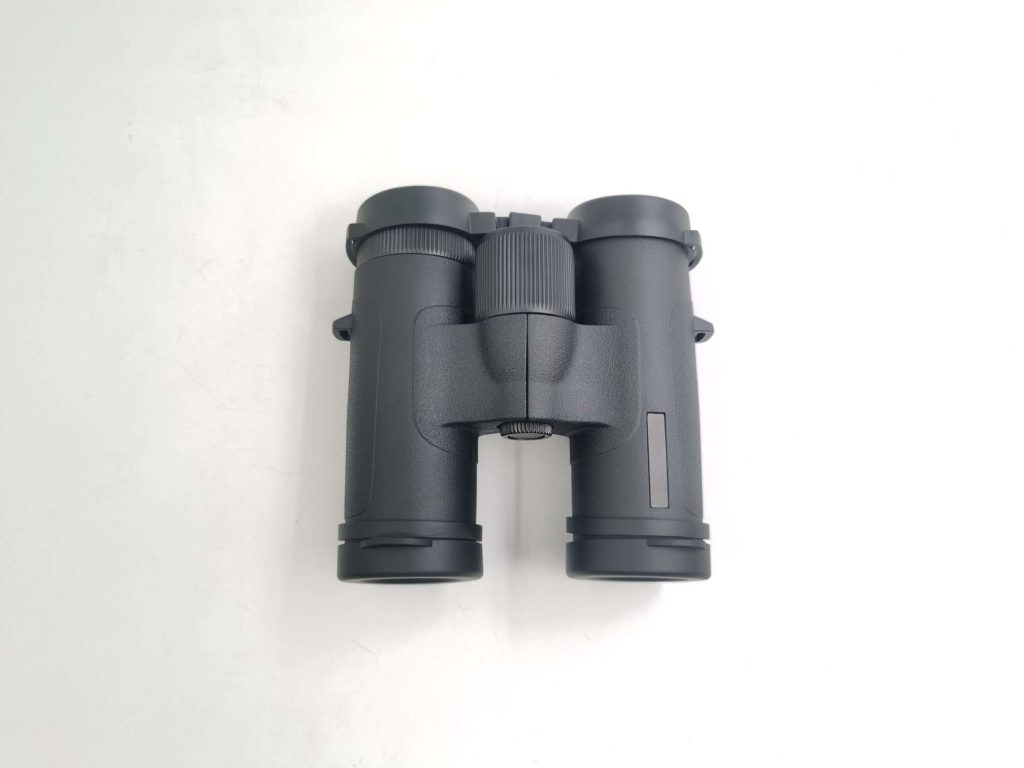
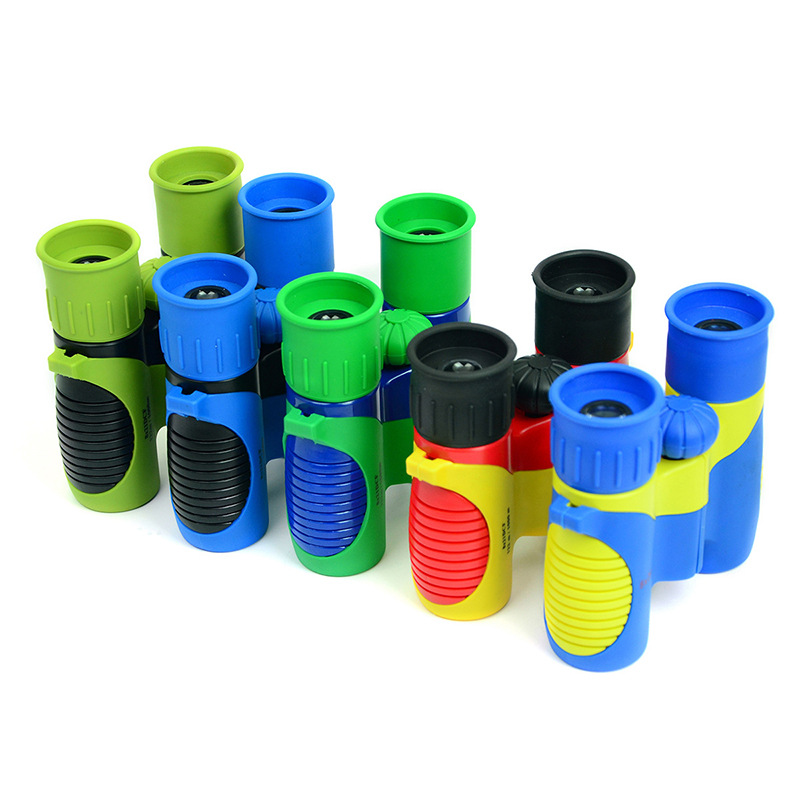
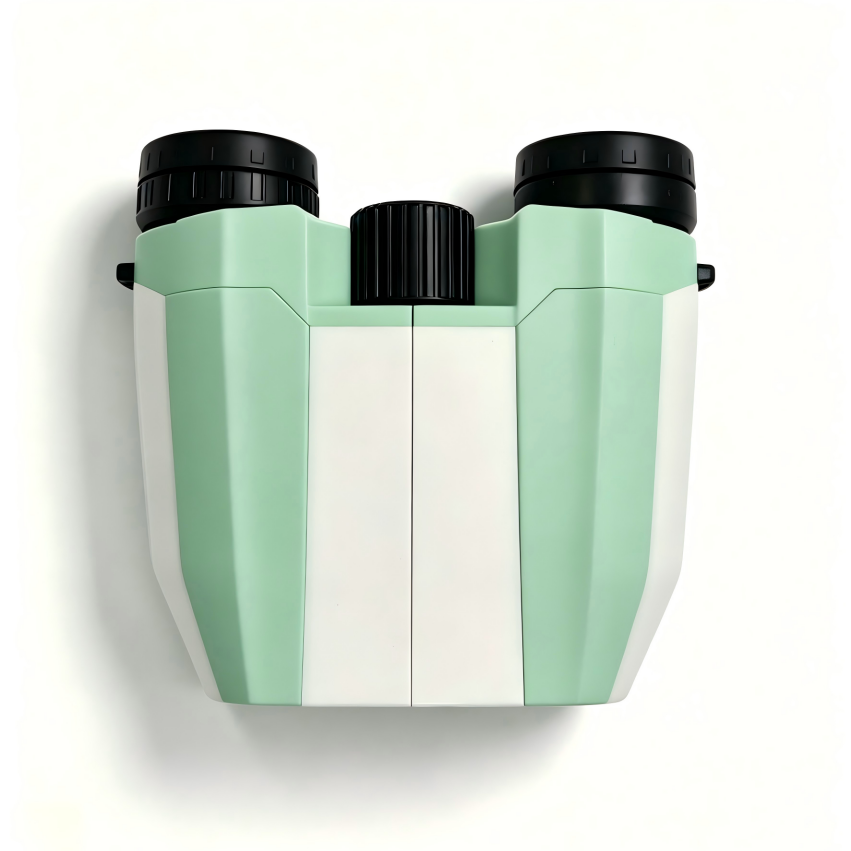
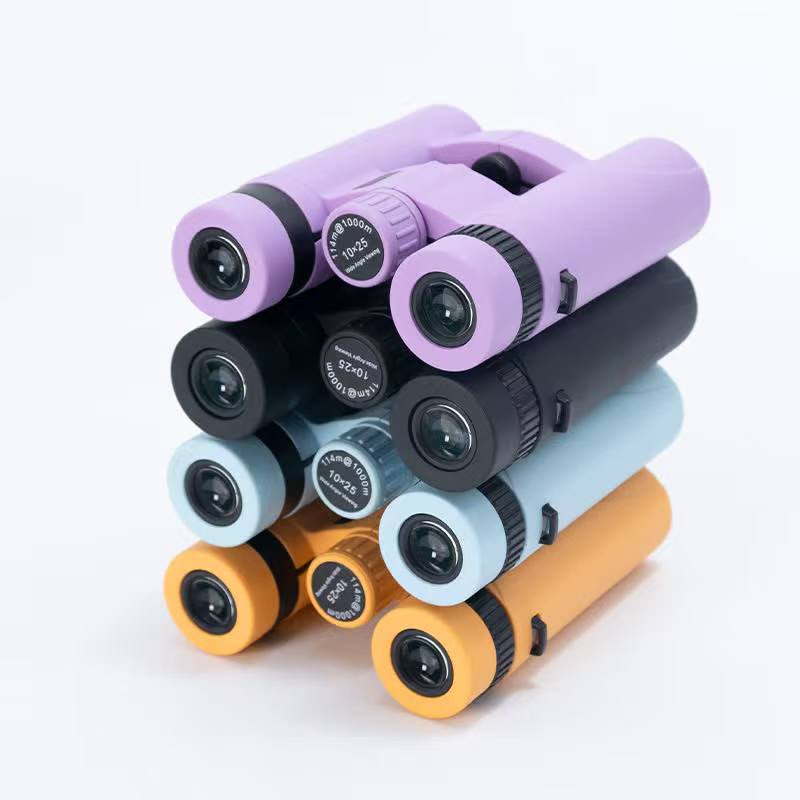
8×25 / 10×25: Pocket-Size and Entry-Level Lightweight Options
The main advantage of these specifications is that they are compact, lightweight, and easy to place in a pocket or the side pocket of a backpack. They are suitable for light hiking, travel, outdoor education for children, and entry-level users.
Their limitation is also quite clear: low-light performance and long-session viewing comfort are usually not as strong as binoculars with larger objective lenses.
8×30 / 8×32: The Main Balanced Route for Hiking
An 8x magnification combined with a 30–32mm objective lens usually offers a better balance between stability, field of view, brightness, and weight.
This makes it suitable for most hiking users. It is also a specification route that outdoor optics brands should pay close attention to when developing mid-range core models.
10×32: Enhanced Long-Distance Observation
For users who need to observe distant ridgelines, wildlife, or terrain details, 10×32 binoculars can provide a stronger sense of reach.
However, this specification places higher demands on handheld stability and optical quality. When defining this type of product, manufacturers need to carefully control the weight and make sure the binoculars still feel well-balanced in the hand.
8×42 / 10×42: More for All-Around Outdoor Use Than Pure Lightweight Hiking
The 42mm class can deliver better low-light performance and a more comfortable viewing experience. But for pure hiking use, the increase in weight and size is also more obvious.
This route is better suited for users who combine hiking with hunting, birdwatching, or other outdoor activities that require stronger low-light performance. It should not be treated as the default answer for every lightweight hiking product line.
Five Questions Brands Should Answer Before Defining Hiking Binoculars
Before developing a hiking binocular product, brands should first answer five key questions:
- Who is the target user?
Are they lightweight hikers, travel users, entry-level birdwatchers, or mountain outdoor enthusiasts? - What is the main usage scenario?
Is the product mainly for daytime hiking, low-light woodland use, long-distance viewing from ridgelines, or a mix of city travel and nature observation? - Where does the product sit in the market?
Is it an entry-level volume model, a mid-range core product, or a premium lightweight professional option? - What is the core selling point?
Is the product simply “light enough,” or is it “lightweight without sacrificing image clarity”? - Can the target cost support better materials, coatings, structural parts, and accessory configuration?
This is important because lightweight design is not only about reducing weight. It also depends on whether the product can maintain a reliable and comfortable user experience after weight reduction.
If these five questions are not clarified in advance, the product can easily fall into one of two traps: sacrificing real user experience just to make the product lighter, or chasing performance so much that it loses the portability hiking users care about most.
Five Dimensions That Should Come First When Defining Hiking Binoculars
Weight and Size
Lightweight design should first make users willing to carry the product. Weight is not just a number. It also needs to be evaluated together with the overall size, packing method, strap system, and balance in the hand.
Handheld Stability
Most hiking users do not carry a tripod, so handheld stability is extremely important. The higher the magnification, the more demanding it becomes to keep the image steady.
In many real hiking scenarios, an 8x binocular may actually deliver higher practical viewing efficiency than a higher-power model that is harder to control by hand.
Field of View and Search Efficiency
Hiking observation often involves quickly scanning hillsides, forests, lakes, or distant trails. A wider field of view can improve search efficiency and help users find the target more easily.
Optical Comfort
Lightweight does not mean clarity, color performance, contrast, and edge control can be ignored. This is especially important for mid-range and premium hiking binoculars.
Users need to feel that the product is lightweight, but not toy-like.
Protection and Durability
Hiking environments often involve rain, dust, temperature changes, accidental bumps, and sweat. Waterproofing, fogproof performance, rubber armor, lens cap design, and the carrying case all affect the long-term user experience.
Balance Strategies for Different Product Types
| Product Route | Core Advantage | Main Risk | Better Positioning Approach |
| 8×25 / 10×25 Pocket-Size Models | Extremely light, compact, and easy to carry | Limited low-light performance and viewing comfort | Best for travel, light hiking, and entry-level users |
| 8×30 / 8×32 Balanced Models | Better balance of field of view, stability, brightness, and weight | Higher cost than 25mm-class models | Suitable as a mid-range core product line |
| 10×32 Long-Distance Enhanced Models | Better for observing distant details | Higher demand on handheld stability | Suitable for mountains, open terrain, and more experienced users |
| 8×42 / 10×42 All-Around Outdoor Models | Better low-light performance and viewing comfort | Larger and heavier | Suitable for users who combine hiking with hunting, birdwatching, or low-light observation |
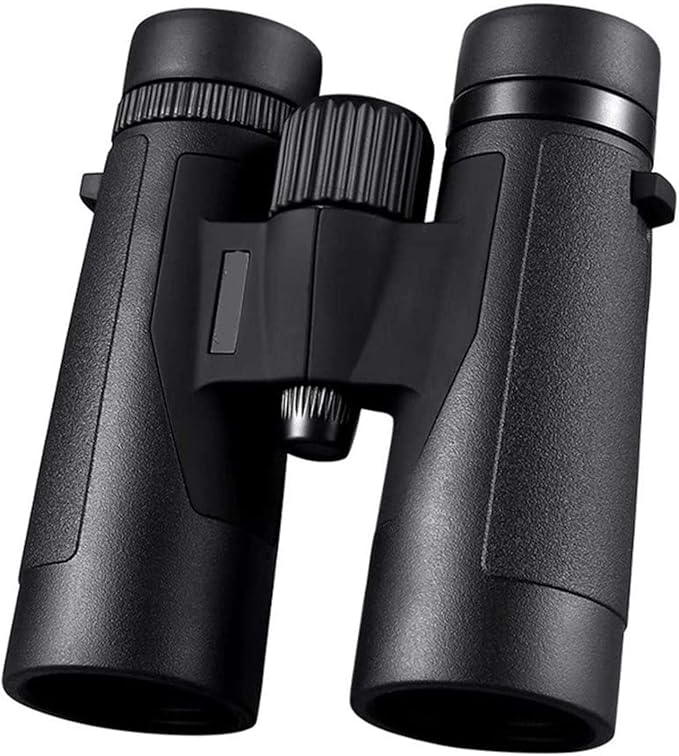
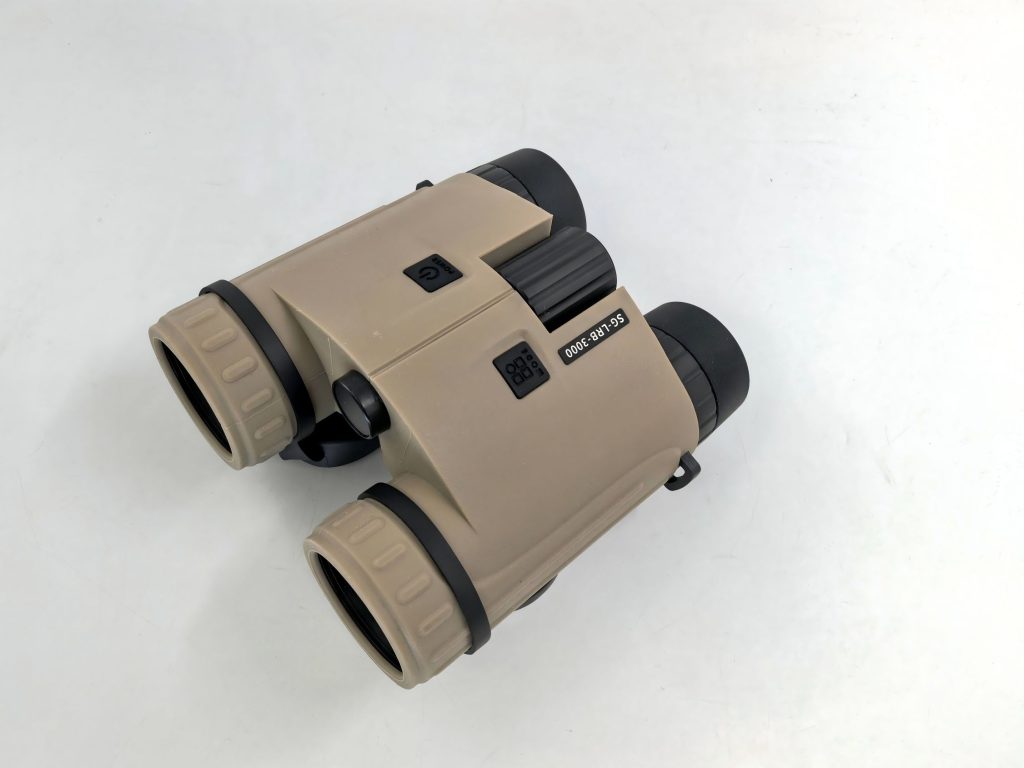
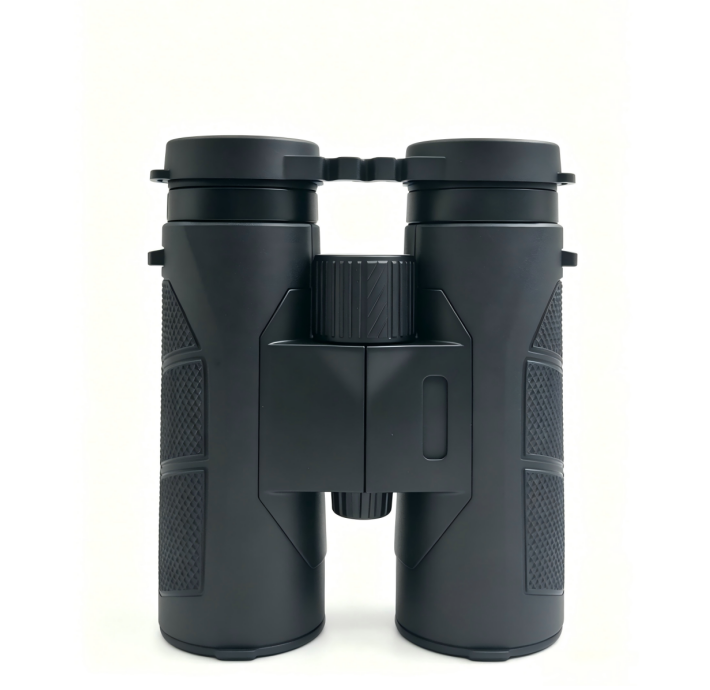
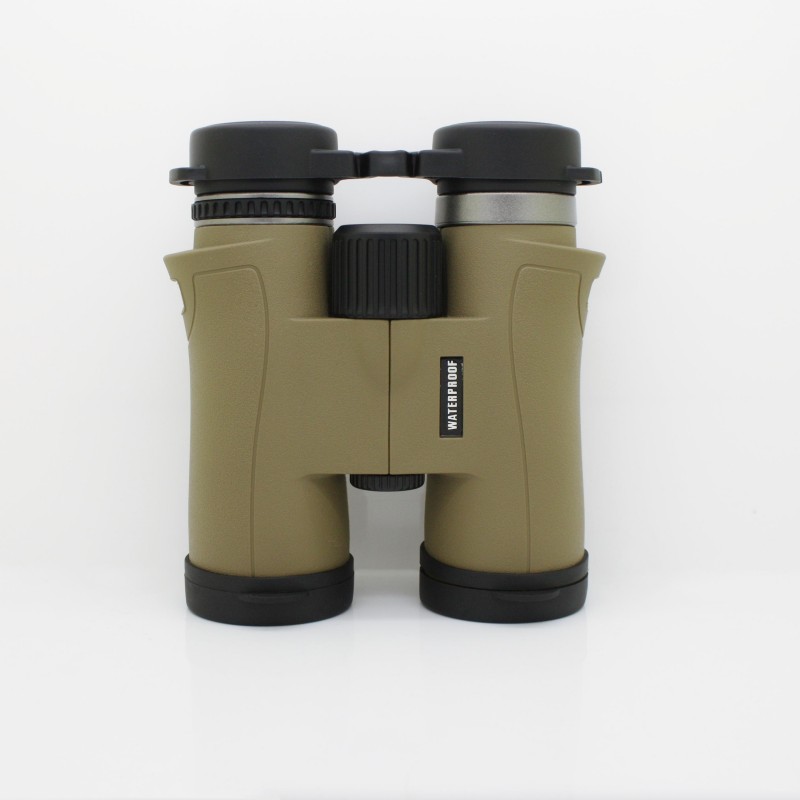
From a procurement perspective, the product route is not about choosing the largest model or the lightest model. The real question is whether the product has a clear role within the overall product line.
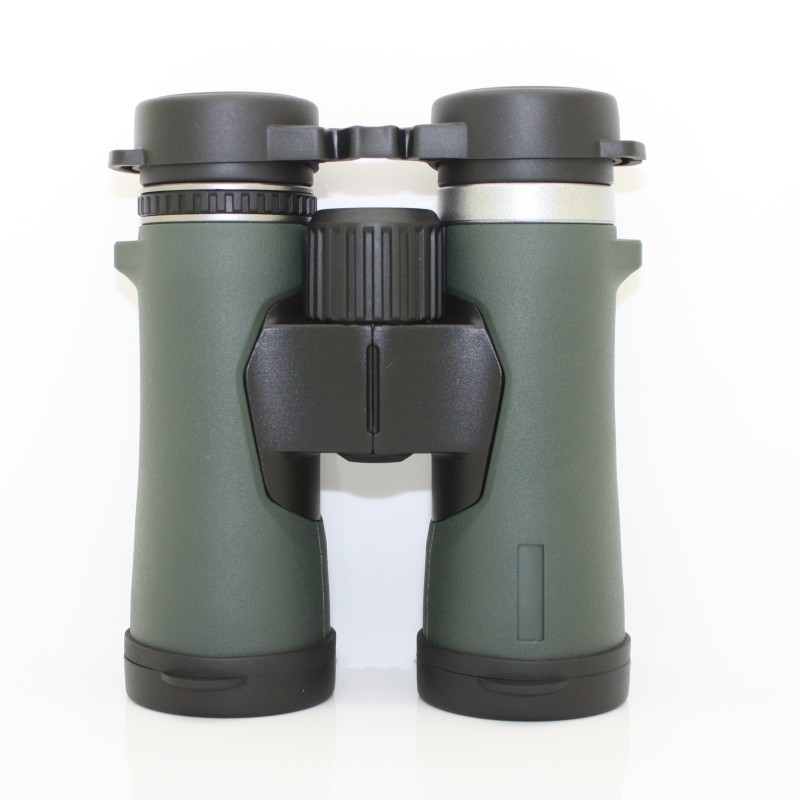
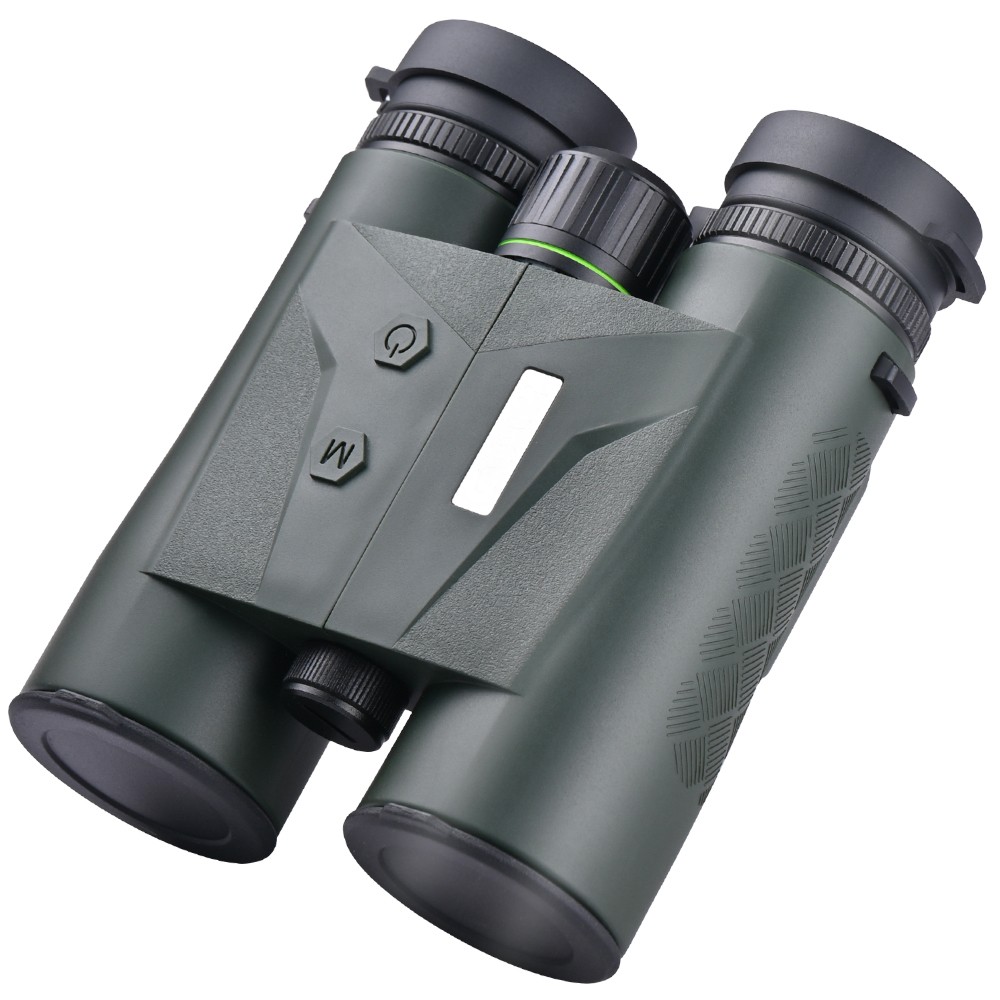
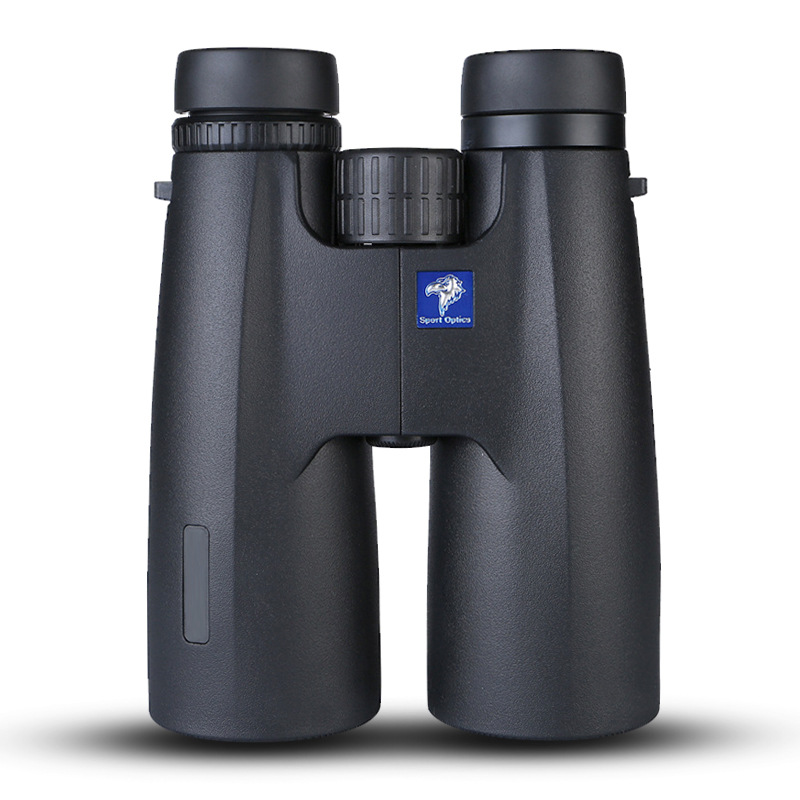
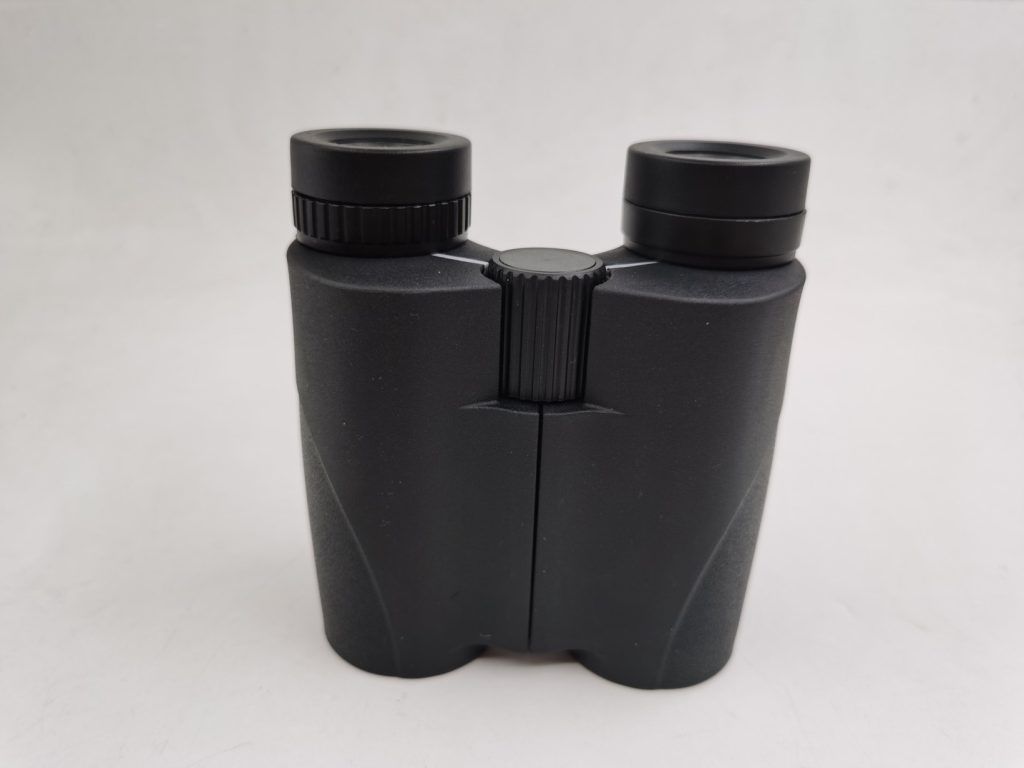
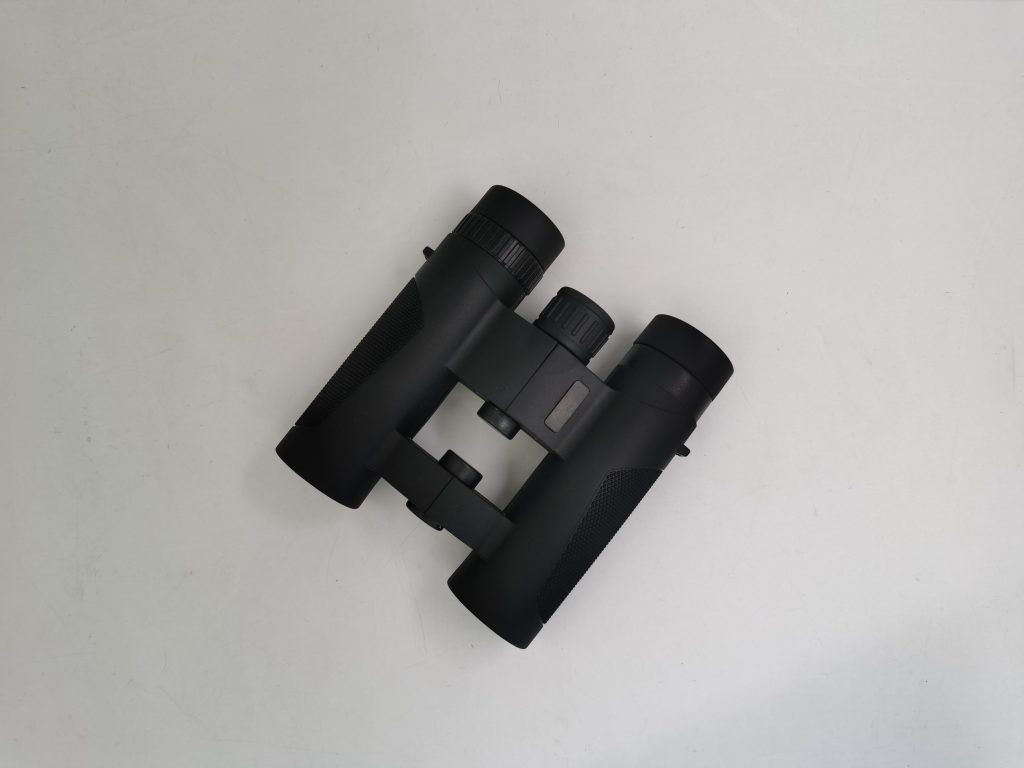
How Should Manufacturers Develop Lightweight Binoculars?
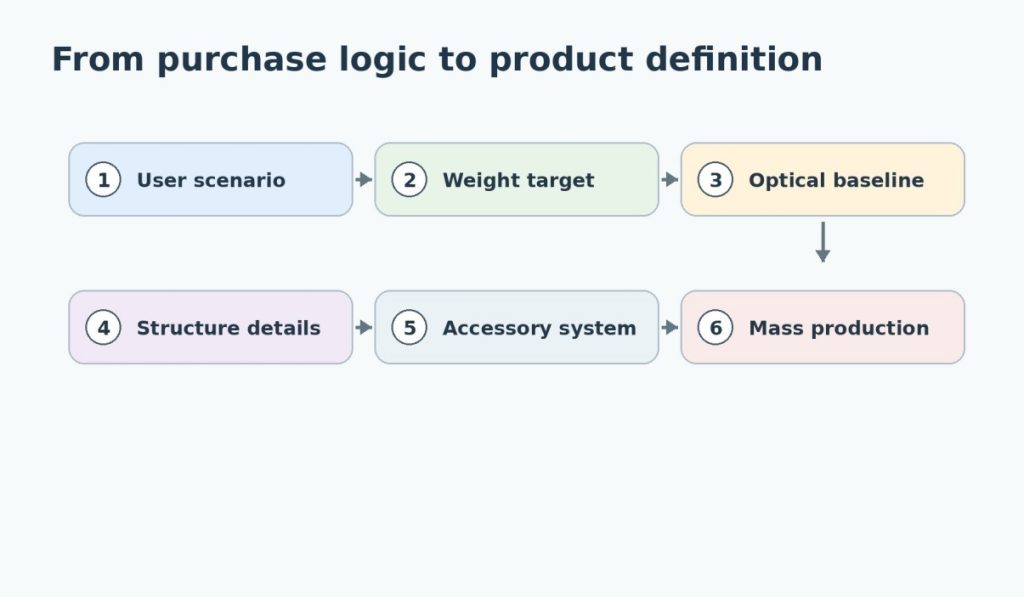
Define the Weight Target Early, Not After the Prototype Is Finished
Lightweight design should be treated as a key requirement from the very beginning of product development. It should not be something manufacturers try to fix by cutting material after the prototype is already completed.
Otherwise, it can easily lead to weaker structural strength, poorer handling, or less stable assembly quality.
Material Selection Should Support the Structure, Not Just the Marketing Story
Magnesium alloy, aluminum alloy, engineering plastics, and composite materials all have their own advantages. Manufacturers need to choose materials based on the target price range, strength requirements, and desired product image.
The goal should not be to use whatever sounds more premium, but to select the material that best supports the product’s actual structure and positioning.
The Optical System Should Match the Product Size
Compact binoculars are not suitable for simply stacking more complex optical structures into a smaller body. A mature design should maintain image clarity, contrast, field of view, and assembly consistency within the limits of the available space.
For lightweight hiking binoculars, optical performance and structural compactness need to be developed together, not treated as separate issues.
Accessories Should Also Be Lightweight
Many brands focus only on the weight of the binocular body, while overlooking the strap, carrying case, lens caps, and packaging.
But hiking users experience the product as a complete carrying system, not just as a bare unit. A truly lightweight product should feel light and convenient from storage to carrying to actual use.
Lightweight Does Not Mean Cutting Corners: What Should Not Be Sacrificed?
Lightweight design should not be understood as simply reducing features or lowering quality. For hiking binoculars, some fundamentals must remain in place.
- Waterproof and fogproof performance should not be sacrificed.
Hiking users often face moisture, temperature changes, and rain, so reliable sealing is still important. - Focus feel should not be sacrificed.
During quick observation, smooth and accurate focusing is often more important than adding complicated features. - Grip comfort should not be sacrificed.
A body that is too small or too slippery can reduce real-world viewing efficiency, even if the product looks compact on paper. - The optical baseline should not be sacrificed.
Lightweight binoculars still need to provide good central sharpness, basic contrast, and acceptable edge performance. - Mass production consistency should not be sacrificed.
Lightweight structures often place higher demands on tolerance control and assembly stability.
At its core, lightweight design is not about doing less. It is about putting limited resources into the areas users can actually feel — the areas that make the product easier to carry, easier to use, and more likely to be used often.
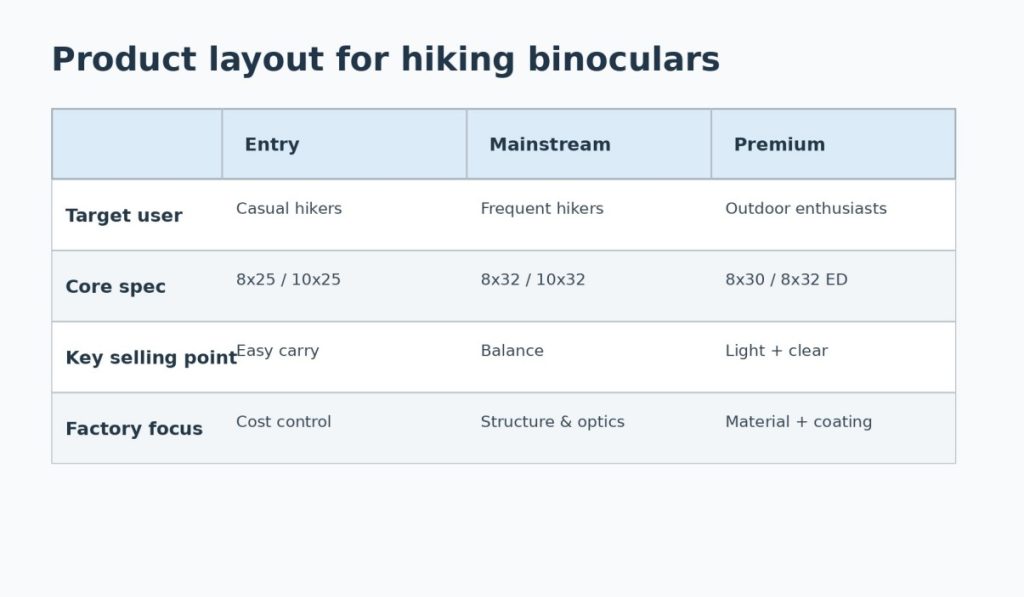
How Should Brands Plan Their Product Line Across Different Price Ranges?
| Price Range | Better Product Logic | Procurement and Development Focus |
| Entry-Level | Lightweight, easy to use, and cost-controlled | Control weight and maintain basic image clarity. Avoid overpromising low-light performance. |
| Mid-Range Mainstream | A balance between lightweight design and optical experience | Focus on optimizing 8×32 and 10×32 platforms, with improvements in coating, grip comfort, and protection. |
| Premium Lightweight | Upgraded materials, coatings, structure, and overall user experience | Use better materials and optical solutions to build a stronger professional lightweight identity. |
What Should Brands Confirm When Communicating With Manufacturers?
When brands discuss hiking binocular development with a factory, several key questions should be confirmed early:
- What is the target weight?
This is one of the basic constraints in defining a hiking binocular. - Will the target user carry the product for long periods?
Does the product need to fit into a pocket, or should it be easy to store in the side pocket of a backpack? - What is the main observation environment?
Will it be used mostly in open daylight conditions, low-light woodland areas, or mixed travel scenarios? - What is the specification priority?
Should the product be lighter, more stable, offer a wider field of view, or deliver stronger low-light performance? - Do the structural material and protection requirements match the target price range?
Material choice and durability should support the product positioning, not push the cost beyond what the market can accept. - Are lightweight accessories needed?
This may include a lightweight strap, carrying case, lens caps, and cleaning accessories. - How will mass production consistency be controlled?
Has the lightweight structure been tested enough for durability and assembly stability?
If these questions are clarified early in the development stage, the factory can configure the optics, structure, and cost more accurately. This also helps avoid repeated revisions during the sample stage.
Development Opportunities for Outdoor Optics Manufacturers Under the Lightweight Trend
The lightweight trend is not only changing how brands make purchasing decisions. It is also creating new development opportunities for manufacturers.
- Build 25mm, 30mm, and 32mm lightweight platforms to meet different price ranges and usage scenarios.
- Develop slimmer, more stable, and easier-to-hold lightweight body structures.
- Optimize the focus wheel, eyecups, and hinge structure so compact binoculars can still deliver a reliable handling experience.
- Develop a complete lightweight accessory system, including straps, carrying cases, lens caps, and travel-friendly packaging.
- Provide scenario-based ODM solutions around hiking, travel, family outdoor activities, and lightweight hunting.
In the future, a factory’s competitiveness will not simply depend on whether it can make binoculars smaller. The real challenge is whether it can maintain strong optical performance, structural reliability, and stable mass production quality within a smaller and lighter product design.
Conclusion
The Real Competitiveness of Hiking Binoculars Is Making Users Want to Carry Them, Use Them, and Keep Them Long-Term
Lightweight design is changing the procurement logic for binoculars in hiking scenarios. Users no longer look only at magnification and objective lens size. They care more about whether the product is easy to carry, stable in the hand, quick to use, comfortable to view through, and reliable enough for real outdoor conditions over the long term.
For brands, the product definition of hiking binoculars should not simply copy the logic of traditional outdoor binoculars. It needs a new product structure built around carry willingness, usage frequency, scenario fit, and price positioning.
For manufacturers, lightweight design is also not just a weight-reduction project. It is a complete development logic that starts from product planning and extends to structural materials, optical design, accessory systems, and mass production validation.
In the future, the most competitive hiking binoculars will not necessarily be the models with the highest specifications. They will be the ones users are most willing to take outdoors, most willing to pick up, and most able to rely on for a stable viewing experience every time.
FAQ
Q: Are hiking binoculars always better if they are lighter?
A: Not necessarily. If a product becomes too lightweight, it may sacrifice grip comfort, stability, protection, and optical experience.
A better goal is to find the right balance between lightweight design and real-world usability.
Q: Should hiking users choose 8x or 10x binoculars?
A: For most hiking users, 8x is usually easier to hold steady and often provides a wider field of view.
10x binoculars are better for users who need stronger long-distance observation, but they also place higher demands on handheld stability.
Q: Which is better as a core product: 25mm or 32mm?
A: 25mm binoculars are better suited for pocket-size and entry-level lightweight product lines.
32mm binoculars are usually a stronger choice for mid-range core models, because they can offer a better balance between brightness, viewing comfort, and weight.
Q: Do lightweight binoculars still need waterproof and fogproof performance?
A: Yes. Temperature changes, rain, and moisture are common in hiking environments. Waterproof and fogproof performance are part of the product’s basic reliability.
Q: What do manufacturers most often overlook when developing lightweight binoculars?
A: The complete carrying system is often overlooked.
Users do not only feel the weight of the binocular body. They also experience the strap, carrying case, lens caps, grip comfort, and how quickly the product can be taken out and used.